Crested Gecko Humidity: The Wet-Dry Cycle That Matters
By ReptileGearLab · Updated October 2026
Quick Take
Aim for humidity between 60 and 80 percent, but treat it as a daily cycle rather than a fixed number. Mist heavily in the evening so the enclosure spikes into the 80s or higher, then let it dry down through the day to around 50 percent, or a little lower, before you mist again. That wet-then-dry rhythm is what these geckos evolved with, and it is what keeps the enclosure healthy.
Do not seal a crested gecko enclosure to hold moisture. They need airflow, and constant high humidity with poor ventilation causes respiratory infections, mold, and skin problems. The mister, substrate, and gauge we use are below. Watch temperature too, because a crestie is far more likely to die of heat than of a dry afternoon.
Crested gecko humidity gets reduced to a single number on most care sheets, and that number is where keepers go wrong. Chasing a constant 70 percent is how you end up with a permanently damp enclosure, mold on the decor, and a gecko with a respiratory infection.
What a crested gecko wants is a cycle: wet, then dry, then wet again. Here is how to run it, and why the advice for a crestie is close to the opposite of the advice for a ball python.
The cycle matters more than the number
In the wild a crested gecko meets moisture as rainfall and morning dew, then spends the day in air that dries out. Recreating that is the actual goal. A good day looks like a heavy evening misting that takes the enclosure up into the 80s or higher, a gradual fall through the night and morning, and a real dry stretch in the low 50s or high 40s before the next mist.
If your gauge reads a flat 75 percent around the clock, that is not a win. Constant saturation is where mold blooms on the substrate and decor, bacteria multiply, and a gecko starts wheezing. Keepers who fix a chronic mold or respiratory problem almost always fix it by letting the enclosure dry out properly, not by adding more water.
How to mist a crested gecko enclosure
- One heavy evening misting is the backbone. Cresties are nocturnal, so misting in the evening puts the moisture there when the animal wakes up and wants to drink droplets off the glass and leaves. Soak the decor and the walls, not just the air.
- Add a light morning mist only if it dries too fast. If your enclosure is down at 40 percent by midday, a small morning mist bridges the gap. If it is still sitting at 70 percent in the afternoon, skip it and improve airflow instead.
- Let it dry down on purpose. The dry stretch is a feature. Do not top up the moment the gauge dips; that is how the cycle gets flattened into permanent damp.
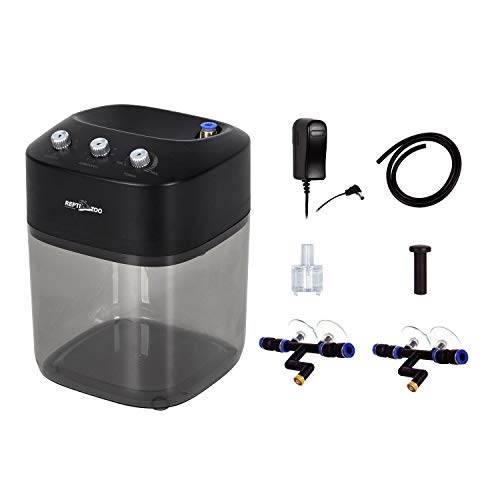
- Automate only if you can control it. A pump mister on a timer is a real help for a busy schedule, but set it to a real cycle. A system that fogs constantly recreates the exact problem you are trying to avoid.
Ventilation is not the enemy, and this is where crestie advice differs
If you have read our ball python humidity guide, the advice there is to cover most of a screen top to hold moisture in. Do not carry that across to a crested gecko. A ball python is a burrowing snake in a dry room; a crestie is an arboreal gecko whose main health risks include respiratory infection from stagnant, saturated air. Screen tops and cross ventilation are part of the design, not a flaw to be taped over.
If your enclosure will not hold humidity at all between mistings, the fix is a moisture-holding substrate and heavier misting, not sealing the vents. And if it will not dry down, the fix is more airflow, thinner or better-drained substrate, and less water, rather than a fan pointed at a lidded box.
Substrate: the buffer that smooths the cycle
Substrate is what keeps the swing from being violent. A moisture-holding base, coconut fiber or a bioactive soil mix, absorbs the evening misting and releases it slowly, so humidity falls gradually instead of crashing an hour after you spray. Paper towel, by contrast, holds nothing and gives you a spike and a cliff.
Keep it damp, never waterlogged. If you can squeeze water out of the substrate it is too wet, and a soaked base with a screen top above it still means constantly damp air. A layer of leaf litter on top slows evaporation further and gives the gecko cover, which is worth more than another inch of soil. Keep sphagnum moss to a covered hide rather than spreading it loose, since cresties have been reported swallowing long strands.
When it drops too fast
A reading that falls from 80 percent to 50 within an hour or two is not a ventilation problem and not a reason to tape up the vents. It almost always means the substrate underneath is dry, so there is no reservoir to release moisture back into the air as the day goes on. Water the substrate rather than the air: mist until the decor and the walls are dripping and the base is damp through, and lay damp sphagnum moss over the top to add buffer. A soaked base is what turns a spike and a crash into a slope.
Some rooms make this genuinely hard. A house running at 25 percent relative humidity, which is normal in winter with a fireplace or forced-air heat, pulls moisture out of an enclosure faster than hand misting twice a day can replace it, and no amount of technique fixes the arithmetic. That is the case where an automated misting system stops being a luxury: several short cycles spread through the day hold a moving trace that two manual soakings cannot. Heat makes it worse, so if you are running a projector or a lamp to keep the room temperature up, expect to be replacing more water than a keeper in a damp climate.
The cost of getting this chronically wrong shows up at shed time. A crestie in air that is too dry for too long sheds in patches instead of cleanly, and keepers tracing a bad shed backwards routinely land on a misting schedule that was not keeping up. An incomplete shed is worth treating as feedback on the humidity cycle rather than as its own separate problem.
Measure it properly
Put a digital hygrometer in the middle of the enclosure, away from the spot you mist, because a probe in the spray zone reads soaked for an hour and tells you nothing about the rest of the day. Ignore the cheap stick-on dials; they are the source of an enormous amount of unnecessary panic and are frequently off by twenty points.
What you are looking for on the readout is movement. A trace that rises after misting and falls steadily to the low 50s is a healthy enclosure. A flat line, high or low, is the thing to fix.
Height matters as much as position. A tall enclosure holds a gradient, and the top dries out well before the substrate does, which is a problem when the animal spends its day near the top. If you only ever read at mid-height you can sit comfortably in the 60s while the gecko is in air twenty points drier. Read at the height your crestie spends its day at, and if the two readings diverge badly, that gap is the thing to close.
The other instrument is the animal. A crestie that stops using its usual perch and stays burrowed down in the substrate is often telling you the air above is too dry, and keepers who resume a proper misting cycle frequently watch the gecko come straight back up to its leaf. Behaviour will not give you a number, but it is a good cross-check on a gauge you have not yet verified.
The bigger danger: temperature
Humidity gets all the attention, but heat kills crested geckos faster. They are comfortable with the enclosure sitting at roughly 70 to 78 degrees. A small warm zone at the very top of a tall enclosure can read into the low 80s without harm, but sustained whole-enclosure temperatures above the low 80s stress them, and the mid 80s can be fatal. A crestie cannot climb out of a hot enclosure the way it would move down a tree in the wild.
This matters here because the two interact. A warm room drives humidity down and tempts keepers to mist more, when the real fix is cooling the room. If your enclosure is running hot, deal with the temperature first: move it out of direct sun, drop or remove supplemental heat, and check what your lighting is adding.
Our call
Run the cycle, not the number. Mist heavily in the evening, let the enclosure dry down toward 50 percent through the day, and aim for a 60 to 80 percent band overall rather than a fixed reading. Use a moisture-holding substrate to smooth the swing and a digital gauge in the middle of the enclosure to see what the curve is doing.
Above all, resist the instinct to seal the enclosure. Airflow is what keeps a humid setup healthy, and a crested gecko is far more likely to be harmed by permanently wet, stagnant air, or by heat, than by a few dry hours in the afternoon.
Recommended
Products related to this guide.




What owners say
Real owner reports from the threads and editorial sources we drew on for this guide.
“For me I usually spray at night and let it dry during the day, you want it to dry down to 50%. It MUST drop, having too high humidity all the time can lead to issues such as respiratory issues and possibly issues with your tank like mold.”
— r/CrestedGecko / Important-Song8050
“I mist at night like 8 or 9pm. It usually goes up to about 90% then isn't down to 50% till 5 or 6pm the next day. I live in a humid area though. Sometimes I do a light mist around 10am on dryer days when humidity hits 60%”
— r/CrestedGecko / Rossabella315
“Ideal temps are 70-80. So I’d try to boost it if you can! Humidity should drop throughout the day to like ≈50 and then spray to 70-80 during the evening.”
— r/CrestedGecko / az6girl
“I only mist in the evenings just before I turn off the light. I will either to a light or heavy mist depending on the humidity.”
— r/CrestedGecko / _Invisible-Child_
“Your best best is to find a mister on a timer and monitor your humidity levels to find the best timing and cadence.”
— r/CrestedGecko / PatientMammoth5059
“I have a very dry house (25% RH) due to the fireplace. We even have three humidifiers, a whole house one and two smaller ones. I recently put together my Mist King, because twice a day misting wasn't cutting it. With me misting manually, the bottom of the enclosure is okay with two mistings (around 60% RH) but the top quickly dries out to below 40%.”
— r/CrestedGecko / MugzySkates
“I think you were right with humidity! I stopped misting for a few days since my hydrometer was around 65 to 70% for days on end. As soon as I started misting, she came back out and has been fine. Back on her regular leaf! I will be getting a better hydrometer to monitor it.”
— r/CrestedGecko / sleepyhuman572
“If it's dropping from 80% down to 50% within 1-2 hours I recommend checking the substrate and making sure it's not dried out, adding some damp moss on top of it and misting until everything drips.”
— r/CrestedGecko / Infinitymidnight
“I've recently had a gecko who's shed wasn't complete because my misting was inadequate”
— r/CrestedGecko / ahkhan86
“I put it on a few hours ago and sprayed it to 80% and just checked and it was at 50%. Thats better then it was earlier but it's still going down way too fast”
— r/CrestedGecko / Different-Win-2601