Best Halogen Basking Bulb for a Bearded Dragon
By ReptileGearLab · Updated August 2026
Quick Take
Buy a halogen flood sized to your enclosure and run it on a dimming thermostat. Halogen puts out infrared A and some B, close to what the sun does, and reptiles pick a basking spot by its light. A lightless ceramic emitter or deep heat projector can't do that. Halogen is the daytime basking source.
Now the part that saves you money. A plain PAR38 halogen flood from the hardware aisle is the same technology as a reptile-branded one, and long-time keepers say so bluntly: you're mostly paying for the label. The catch is finding one. Efficiency rules pulled most high-wattage halogens off store shelves, and some won't ship to every US state, which is why we often land on a reptile-branded flood that's reliably stocked.
So you're deciding three things: brand or generic, what wattage, flood or spot. Here's what we'd buy, and why: See picks ↓

If you keep a sun-basking reptile like a bearded dragon, the basking bulb is the piece that most directly mimics the thing it evolved under. Done right, your animal thermoregulates the way it should. Done wrong, no amount of ambient heat fixes it, because the animal won't recognise a spot it can't see to bask on.
The answer is settled and cheap. All the confusion lives in the details: brand, wattage, beam, and a supply quirk almost nobody warns you about.
Why a halogen, and not a ceramic emitter or DHP
Keepers are more united on this than on anything else about basking. A halogen flood emits visible light plus infrared A and a little B, close to the spectrum of sunlight, and that combination is what a basking reptile is looking for. A ceramic heat emitter and a deep heat projector both make heat without the sun-like light, which makes them good for ambient or night warmth and poor as a basking source, because the animal orients to brightness. A lightless heater can hold the air at exactly the right number and still fail the animal, because nothing ever signals "bask here."
So: halogen for daytime basking. Ceramic and DHP for the other jobs.
Reptile-branded or a generic hardware-store bulb?
A PAR38 halogen flood is a mass-market lighting product. The reptile-branded versions are, electrically, the same thing with a higher price and a gecko on the box. Keepers who have worked that out buy generic and never look back, and we don't blame them.
Two reasons to buy the branded flood anyway. Availability, covered below, which matters more than it sounds. And consistency: a reptile-branded flood is stocked year-round, ships reliably, and comes in the wattages keepers use, so you're not gambling on whether a hardware-store SKU is in stock this month. If a few dollars saved matters more than that certainty, buy the generic. If you'd rather not think about it, buy the branded one. It's the same bulb doing the same job either way.
The supply catch nobody warns you about
Energy-efficiency regulations have pushed retailers toward LEDs, and the high-wattage PAR38 halogens keepers rely on have quietly vanished from most hardware stores. Keepers describe hunting for them locally, coming up empty, then ordering GE or Philips PAR38 halogens online instead.
There's a second wrinkle on top of that. Some of those higher-wattage halogen floods won't ship to every US state, and keepers specifically report certain wattages refusing to deliver to California. None of this makes the bulb wrong. It does mean "grab one at the store" is no longer reliable advice, and it's the honest reason a reptile-branded flood that ships anywhere and stays available earns its small premium with a lot of people.
Wattage: size it to your enclosure
More people get wattage wrong than get brand wrong. The right number depends on your enclosure size and how far the basking surface sits from the bulb, not on one universal figure.
- A standard 4x2x2 with the basking spot raised toward the bulb is usually happy in the 75-100W range.
- A large or tall enclosure needs much more. One keeper runs a 250W lamp, two in winter, to hold a basking spot in a 240-gallon tank.
- Too low is the common mistake. One keeper says flatly that an 80W bulb "will not give you much heat at all above room temperature" in a big tank.
Buy a sensible wattage for your tank, then adjust the basking height and confirm the actual surface temperature with a thermometer rather than trusting the box.
Flood, not spot
Floods throw a wide beam. Spots throw a tight, concentrated one. For most basking setups you want the flood. A wide beam warms a whole basking platform evenly, so the animal can shuffle around and settle where it likes, while a narrow spot packs the heat into a small circle that's easy to overshoot and harder to sit on comfortably. Keepers pick floods for that even spread, and one recurring complaint about a particular reptile-branded bulb is that its beam is too narrow. Given the option, take the flood.
Always on a dimming thermostat
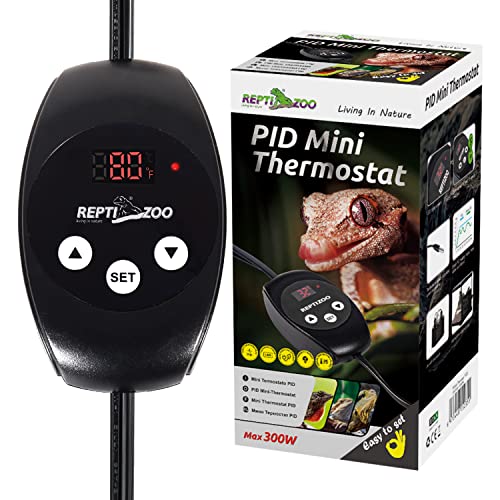
A basking bulb is a powerful heat source pointed at an animal. It never runs unregulated. For a bright bulb you want a dimming thermostat rather than an on/off one: an on/off unit cycles a visible bulb on and off all day, which flickers the light and, as keepers note, blows the lamp faster. A dimmer eases the power up and down and the bulb survives it.
One keeper's summary: a dimming thermostat "preserves the life of the lamp, prevents the enclosure from overheating and prevents a fire hazard." Experienced keepers refine that by sizing the wattage so the bulb barely needs dimming at full basking temperature, then setting the thermostat probe on the cool side purely as an overheat cutoff. Our reptile thermostat guide covers which dimming unit to buy and where to put the probe.
What about metal halide or mercury vapour?
Worth a sentence, since keepers bring it up. Metal halide and mercury vapour lamps put out far more light, and mercury vapour gives you UVB and heat from a single bulb, which some keepers consider the top tier. They're also pricier, run hotter, need specific fixtures, and can't be dimmed the same way, so they're a specialist upgrade rather than the default. For most keepers a halogen flood plus a separate UVB tube is simpler, cheaper, and easier to control. Chasing maximum light output in a large open enclosure is where the halide conversation starts.
What we'd buy
A halogen flood in a wattage that suits your enclosure, on a dimming thermostat, with the basking temperature confirmed by a thermometer.
Generic PAR38 if you can source one. A reliable reptile-branded flood if you'd rather it just show up and always be available. It's the same sun-like heat either way, and it's the thing a ceramic emitter and a deep heat projector cannot give your basking animal.
Recommended
Products related to this guide.



What owners say
Real owner reports from the threads and editorial sources we drew on for this guide.
“A halogen bulb is the best source of heat overall because they produce infrared A and some B like the sun. Zoomed makes a good bulb, Arcadias halogen happens to have a narrow beam, maybe try a different brand.”
— r/reptiles / Zoologist36
“Nah, halogens are the best basking lamps in most situations. CHEs just don't offer a particularly sunlike energy so they're mainly ambient heaters.”
— r/reptiles / _NotMitetechno_
“I buy par38 halogen floods from the hardware store. They work great!”
— r/BeardedDragons / Jenxadactyl
“I buy the Arcadia branded halogen lights from Petsmart. You’ll just be paying more for the reptile brand name then if you were to buy it generic from Home Depot haha.”
— r/BeardedDragons / Enimi95
“The 72 watts work just fine, I get temps well over 120 without a dimmer with the 72 watt. Now the real issue is finding them as most places like homedepot stopped selling all halogens in place of led. I just order the ge or philips 72 watt par38 halogens off amazon.”
— r/BeardedDragons / Usual_Platypus_1952
“For me it says they don’t ship to California on Amazon for the 72 W halogen flood light and same for the 90W.”
— r/BeardedDragons / 65mustangsandy
“It depends on your heating needs. For my 240gal tank, I use a 250w lamp [two in the winter] to maintain a 95⁰F basking spot. An 80w bulb will not give you much heat at all above room temperature.”
— r/BeardedDragons / Chuck_Walla
“Be sure your heat source is connected to a dimming thermostat. It preserves the life of the lamp, prevents the enclosure from overheating and prevents a fire hazard.”
— r/BeardedDragons / NoFinding7044
“I just bought this exoterra bulb a week ago and it already blew (first photo). Are the cheap halogens on Amazon any good (second pic)? If I’m going to go through these things quickly I’d rather not b”
— r/reptiles / mtfoxx3
“Ya that's one of the reasons that I'm leaning towards a flood lamp like in the link, and without using the reflector dome... I want a nice wide spread instead of reflecting it all to one spot.”
— r/BeardedDragons / Qweiopakslzm
“Fyi halogens dont put out much light. If you use a metal halide you can x10 the output :)”
— r/reptiles / x69minecraft