Do Ball Pythons Need UVB? What Keepers and Research Say
By ReptileGearLab · Updated October 2026
Quick Take
No, a ball python does not strictly need UVB, and a well-kept snake without it is not doomed. But providing a low level of UVB is a genuine upgrade to its health and worth doing, as long as you treat it as a shade-dweller.
Ball pythons are crepuscular and sit in Ferguson Zone 1, the lowest UV band. That means a weak, low-output lamp giving a basking reading of roughly UVI 1.0, plenty of shade to retreat into, and never a bright desert bulb. Use a low-percent T5, not a coil and not a 10.0.
If you decide to add it, the lamps and the one meter you need are below.
For years the standard advice was simple: ball pythons are nocturnal snakes, so they do not need UVB. That answer is not wrong, exactly, but it is out of date, and it is the reason this question starts an argument in every keeper group.
Here is the straight, current version. A ball python does not need UVB to survive, because it gets the vitamin D it needs from whole prey. But a growing body of research, and a lot of keepers, now agree that a low level of UVB does real good for the animal, and that giving it is cheap, easy, and low-risk when you do it correctly. The catch is that "correctly" for a shade-dwelling snake looks nothing like the setup you would give a bearded dragon.
The old answer, and why it changed
The reason "snakes do not need UVB" became gospel is that it is technically true for survival. A reptile uses UVB to make vitamin D3 in its skin, which it needs to use calcium. A ball python fed whole rodents already gets D3 from the liver and organs of its prey, so it does not depend on sunlight to avoid metabolic bone disease the way an insect-eating lizard does. On that narrow point, the old advice holds.
What changed is the science caught up with the rest of the story. Research over the last decade, much of it building on Dr. Frances Baines and the Ferguson zone framework, found that UVB and UVA do more than make D3. They support the immune system, they drive natural basking and day-night behavior, and reptiles including snakes can see ultraviolet light, so it is part of how they experience their world. Ball pythons are crepuscular, active at dawn and dusk, which means in the wild they do meet low levels of sun. Denying them any UV is not neutral; it just quietly removes something they evolved with.
So do you need it, or not
Both things are true at once, which is why the debate never dies. You can keep a healthy ball python for its whole life with no UVB, on good husbandry and a proper diet, and thousands of people do. And you can measurably improve its wellbeing by adding a little, and a growing share of experienced keepers now do exactly that. It is not a survival requirement; it is an enrichment upgrade with real evidence behind it.
Our take: if the cost and effort are small, and the downside of doing it wrong is avoidable, a low-level UVB gradient is worth adding. The only way to get it wrong is to treat a shade-dwelling snake like a desert lizard, so it comes down to picking the weak lamp and giving the animal shade.
If you add it, do it the Zone 1 way
This is the part people get wrong, and it is the part that matters most for the animal. Ball pythons are Ferguson Zone 1, the band for crepuscular and shade-dwelling species. In the wild they see an average UV index near zero and a maximum somewhere around 1.0 to 1.4 on the rare occasions they venture out. Your goal is to recreate that: a basking reading around UVI 1.0, and a big shaded zone where the reading falls to nothing.
- Use a low-output lamp. A low-percent T5 HO tube, a 5.0 or a 7%, or a compact shade-dweller kit built for exactly this. Never a 10.0 or a desert 12-14% lamp, and never a coil bulb, which produces UV unevenly and has a history of eye problems.
- Aim for UVI around 1.0 at the basking spot. Not 3, not 5. This is a shade-dweller, so the target is low. The number depends on the lamp and the distance, which is why the meter below is not optional if you want to be sure.
- Give it shade to escape into. A UVB gradient means the snake chooses its dose. Mount the lamp over the warm end with the animal's hide options placed so it can get completely out of the light. A snake that cannot escape UV is being over-exposed.
- Mount it right and replace it. Run the tube along roughly half the enclosure, on the same side as the heat, and replace it about once a year, because UVB output fades long before the light looks dim.
UVB is not the same as light
This trips up more keepers than any spec question. A low-output T5 UVB tube puts out very little visible brightness, so an enclosure running heat and UVB alone can still look like dusk at midday. The snake is getting its UV and no real daylight cue, which is half a photoperiod. Keepers who notice it add a plain bright daylight LED bar alongside the UVB, and they tend to describe the change in terms of the enclosure finally reading as day, which is also when you can see your animal properly.
The other half of a photoperiod is the dark. Running the visible lights on a timed cycle of roughly twelve hours on and twelve off gives the snake a night it can rely on, and keepers report their ball pythons moving around more once the enclosure goes properly dark. A lightless heat source is what covers the overnight temperature, which is why a projector or an emitter belongs in that slot rather than a bulb that glows.
The gear: a weak lamp, a meter, and shade you already have
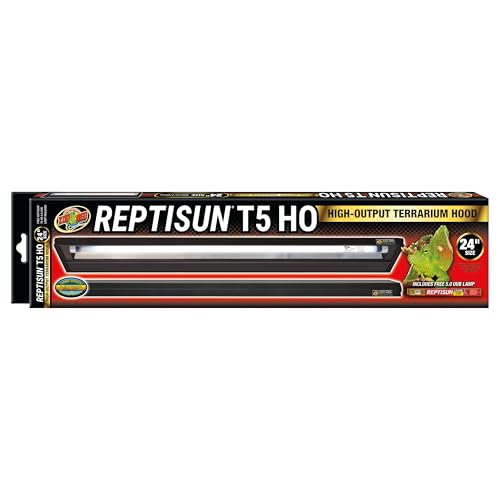
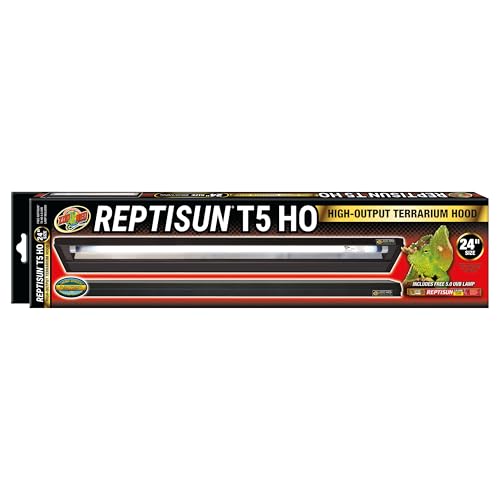
The lamp is a low-output T5, either a Zoo Med ReptiSun 5.0 tube in a reflector or a compact Arcadia shade-dweller kit that comes as one piece. The one accessory worth the money is a Solarmeter 6.5, because UVB is invisible and the only way to know you are giving a Zone 1 dose and not accidentally cooking your snake with UV is to read the number. Everything else, the hides and the gradient, you already build for a ball python anyway.
You do not need a fancy setup here. A weak tube, set at a distance that reads about UVI 1.0 on the meter, over an enclosure that already has good hides, is all it takes. The picks below are the specific low-output lamps that fit a standard ball python enclosure and the meter that keeps you accurate.
If you want the specifics without the debate: in a 4x2x2 a 22-inch T5 tube in the low-output, shade-dwelling grade is the configuration keepers settle on, and the one to avoid is a desert or dragon-grade bulb, which is built for an animal that basks in open sun. The honest exception is a small starter tub, where fitting a linear fixture properly is awkward and the sensible plan is to add UVB when the snake moves into its adult enclosure.
And it helps to be straight about the stakes, because the two camps talk past each other. A ball python without UVB is not going to drop dead; plenty have lived long lives without it, which is why the old guard is unconvinced. The argument for adding it is that the animal does better with it and has it in the wild, not that its absence is an emergency. That is a weaker claim than some advice implies and a stronger one than "mine was fine" allows.
Our call
If someone tells you a ball python must have UVB, they are overstating it; if someone tells you UVB is pointless for a nocturnal snake, they are a few years behind. The truthful answer is in the middle: it is optional, it is beneficial, and it is easy to add well. We would give a ball python a low-level UVB gradient, because the evidence for a health benefit is real and the cost of doing it right is a cheap tube and a little planning.
Just respect what the animal is. A ball python is a shade-dweller, not a basker. Keep the lamp weak, keep the shade generous, read the UVI with a meter, and the upside is yours with none of the risk. Skip all of that and reach for a bright desert bulb, and you have made the enclosure worse, not better.
Recommended
Products related to this guide.


What owners say
Real owner reports from the threads and editorial sources we drew on for this guide.
“To allow your snake to thrive, UVB is a necessity. However, this is a pretty new development. There are still plenty of owners who have not utilized UVB yet and plenty more who don't use it. Your snake wouldn't die without it and would actually still live a good life without it. You have to know what you're comfortable with handling, especially since uvb done incorrectly can also cause harm.”
— r/ballpython / Snoo-47921
“The only UVB that's safe to use with ball pythons is a T5 fluorescent linear bulb. If you've got a bulb that screws into a dome that's also used for heating, then the UVB you have is not safe to use and will need to be replaced.”
— r/ballpython / totallyrecklesslygay
“I am all for UVB and encourage everyone to do it. That being said too strong of a UVB bulb can negatively effect your animals, so learn about the different strengths.”
— r/ballpython / Olyna_Exotics
“Depends on your mesh % and design as that can greatly change your needed uvb % and distance. Generally you would want a shadedweller 2.5% at half the length of the enclosure.”
— r/ballpython / CarlTheOneInvoker
“I'm definitely open to learning about and doing UVB, I just wasn't aware till responses on this post that it was recently deemed a necessity, but along with the rest of my research I will provide UVB, just was making sure with this post, so thank you”
— r/ballpython / bettamoon_scales
“UVB isn't that complicated. If you're starting off in a 4x2x2 there's no reason not to get one with your initial setup. You'd want a 22" T5 bulb with a low intensity UV output (forest/shade dwelling type bulb, not desert/dragon).”
— r/ballpython / skullmuffins
“Currently we know UVB is necessary for them to thrive, even though your snake won't directly die without it and that it's new info for many old-guard keepers.”
— r/ballpython / kingsnake_e
“In my opinion I'd go ahead and get the LED. My enclosures are way too dark with only the heat and uvb, at least in my opinion.”
— r/ballpython / Excellent-Error-8697
“My leds are both for sustaining flora and lighting the enclosure, set to be on/off in a 12hour cycle.”
— r/ballpython / eomfd2010
“I do have a uvb light and in have been turning off the lights at night and i notice he will move more that way.”
— r/ballpython / Devilinthesh33ts