Best Leopard Gecko Enclosure (Size and Type Keepers Recommend)
By ReptileGearLab · Updated August 2026
Quick Take
For an adult leopard gecko, buy a 36x18x18 inch enclosure. The hobby calls that a "40 gallon," and we'd treat it as the floor rather than the target. Bigger is better in our view, and the extra footprint is cheap insurance against wishing you'd bought it. Skip the 10 and 20 gallon tanks the pet store still sells; they're outdated and too small for an adult.
Two things matter more than the gallon number on the box. Go by dimensions, because tanks get labeled inconsistently and a "40 gallon" and a "50 gallon" can be the identical 36x18x18. And prioritise floor space over height. A leopard gecko lives on the ground, so a long, wide footprint beats a tall one, and the height only has to clear your lights and a hide.
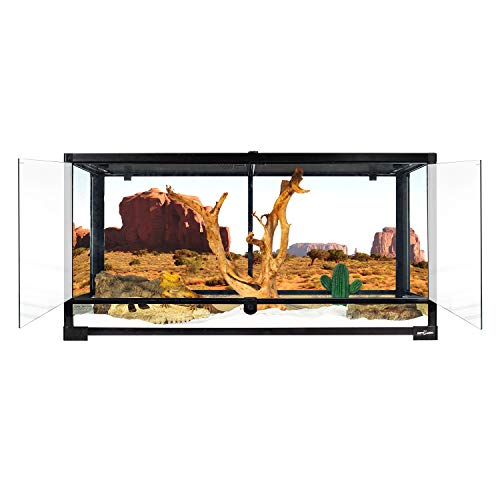
Here's what we'd buy: the front-opening enclosure that hits the minimum, the bigger upgrade if you have the room, the affordable direct-sold option, and the one accessory you cannot run the heat without. See picks ↓

Leopard gecko enclosure advice has moved a lot in the last few years and the pet store hasn't kept up. Those 10 and 20 gallon tanks are still on the shelf, still sold as "starter kits," and they're the single most common thing experienced keepers tell new owners to upgrade from. The current floor is more than double that.
Housing one well isn't hard, though. A leopard gecko is small, ground-dwelling, and doesn't need high humidity, which means glass works fine, the enclosure doesn't have to be enormous, and the decision comes down to a few numbers. Size is where most of the money goes, so start there.
How big does it need to be?
The community minimum for a single adult is a 36x18x18 inch enclosure, sold as a "40 gallon." Keepers say it plainly: that's the bare minimum, not a target, and the sentence right after it is always "bigger is better." Room to roam is part of the reason. The bigger part is the temperature gradient. A leopard gecko needs a warm end and a cool end it can move between, and a small tank can't hold that spread, so the animal ends up too warm everywhere with nowhere to escape to.
Older care sheets said 10 or 20 gallons, and you'll still run into that number. It's out of date. One longtime keeper's phrasing sums it up: 20 gallons is "the bare minimum to survive," 36x18x18 is the "bare minimum to thrive." The guidance moved for good reasons, and it's still drifting upward, with some keepers now running larger setups as standard.
Go by dimensions, not gallons
Ignore the gallon label. Read the three numbers. This tip shows up in every leopard gecko enclosure thread because it stops people buying the wrong box: aquarium-style gallon ratings are calculated in ways that mean nothing to a reptile keeper, and the same 36x18x18 footprint gets sold as a "40 gallon" by one brand and a "50 gallon" by another.
So shop by footprint. You want roughly 36 inches long by 18 inches deep at minimum. Whether the sticker says 40 or 50 gallons is noise. Match the footprint and you've matched the enclosure keepers are recommending, whatever the marketing calls it.
Floor space beats height
A leopard gecko is terrestrial. It walks and hunts on the ground, and unlike a crested gecko or a chameleon it makes no meaningful use of vertical space. Length and width are the dimensions that count. Height beyond what you need to mount a light and fit a hide is close to wasted.
That matters because most pet-store tanks get bigger by getting taller, which adds gallons without adding the floor a gecko uses. Keepers raise this distinction directly, pointing out that a taller tank can hit the same volume as a wide one while giving less usable ground. Between a tall enclosure and a wide, low one at the same price, we'd take the wide one every time for this animal. A 36x18x12, wide and low, is a legitimate option for maximising floor as long as you keep the length up.
Front-opening, and escape-proof
Front doors are the better design here for the usual reasons: you approach from the side instead of looming overhead, and daily maintenance is easier. For a ground-dwelling leopard gecko they matter less than they would for a skittish arboreal species, but they're nicer to live with, and we'd pay a small premium for them.
Closing securely matters more. Leopard geckos aren't climbers or famous escape artists, and keepers report animals staying put for years in a decent enclosure. When one does get out, the cause is a poorly fitted lid or door, or somebody forgetting to latch it, not the gecko engineering its way to freedom. Check that the doors seat cleanly, and on a front-opening tank spend the couple of dollars on a lock if there are curious kids or other pets in the house.
Glass, PVC, or wood?
A dry-climate animal makes this easy. A glass tank with a screen top is completely appropriate for a leopard gecko, because the ventilation that would bleed away a ball python's humidity is a non-issue for a species you're keeping deliberately dry. The cheap, widely available glass terrarium is a correct choice here, not a compromise.
Once you go big, though, other materials start winning on price. Keepers point out that solid-panel makers like New Age Pet's EcoFlex sell a 4x2x2 for around what a glass 36x18x18 costs, so if you're stretching to a larger footprint, PVC or wood can be better value and holds heat on less wattage. Glass for a standard 40-gallon setup. Price the PVC and wood options if you're upgrading past that.
What is too small, and the pet-store trap
The clear "do not buy" is the starter kit built around a 10 or 20 gallon tank, plus anything in the 25-gallon range for an adult. Space to move is only half of it. A small box can't hold a proper warm-to-cool gradient, so the animal cooks with nowhere to retreat. One keeper's framing sticks: being stuck in a too-small tank is like being stuck in a 75-degree house with no cooler room to go to.
If money is the constraint, the fix isn't a smaller tank. It's a cheaper version of the right size. Direct-from-maker options like Dubia.com sell leopard-gecko-appropriate enclosures that undercut the display-grade glass tanks, and that one's in the picks below.
What you need to add
The enclosure doesn't heat or light itself. A leopard gecko needs a controlled warm end, which means an overhead heat source (or an under-tank heater) run through a thermostat and never plugged straight into the wall. Add low-level UVB and three hides: warm, cool, and humid. Our leopard gecko heating guide covers why keepers have largely moved off heat mats to overhead heat, and what to run instead.
What we'd buy
At least a 36x18x18 (40 gallon). Judge it by those dimensions rather than the gallon sticker, and favour floor space over height, because your gecko lives on the ground. Glass with a screen top is fine for a dry-climate animal, front-opening is the nicer design, and go bigger whenever you have the room and the budget. Put the heat on a thermostat. And leave the pet-store starter tank on the shelf.
Recommended
Products related to this guide.


What owners say
Real owner reports from the threads and editorial sources we drew on for this guide.
“It used to be smaller, but with the new information over the past few years 40gal is the minimum and bigger than that would be phenomenal. It's for the heat gradient and floor space. 36"x18"x18".”
— r/leopardgeckos / ImAnNPCsoWhat
“This is from the beginner's guide, it would be better phrased as "20 is the bare minimum to survive" while we consider 40g the "bare minimum to thrive". In reality that's a bit of a reductive and imperfect summary but gets across the necessary information to the average keeper. The beginner's guide needs updating, it comes from a time when we had to beg people to upgrade from a 10 gallon. All other resources we have recommend 36x18x18 or close for adults.”
— r/leopardgeckos / are-pea
“Go by dimensions over gallons. Just assume that “40 gallons” is 36”x18”x18”. The way they do gallons for tanks is really weird”
— r/leopardgeckos / Rathoe9070
“Dubia.com has a 33 gallon tank (36x18x12) and Zoo Med makes a 40 gallon (36x18x18). Second tank meets the volume requirement, but has less floor space.”
— r/leopardgeckos / ocellijelli
“Minimum is 36x18x18 (inched) but bigger is always better. As long as you have a good enclosure, they typically stay put. Escapes usually happen due to poorly fitted tops/doors or when someone forgets to close the tank back up. I've had mine for 11 years and she has never gotten out. Very good instincts not to to trust the pet shop!”
— r/leopardgeckos / Pentavious-Jackson
“100% this. adding to explain why 25 is too small; there simply isn't enough room for a proper temperature gradient. your leo will get too hot and have no place to escape the heat- imagine being stuck in a 75⁰ house at all times”
— r/leopardgeckos / No_Ambition1706
“hello! 40gal is the absolute minimum requirement for an adult leo. bigger is always better, but 25gal is 100% too small.”
— r/leopardgeckos / PuzzyTheClown
“I would personally never use smaller than a 40gal for any leo let alone an adult, while 40g may be the bare minimum it's still very small for a leopard gecko to spend its entire life in which Is why mine Is personally in a bigger setup. If your going to own a leopard gecko or even multiple then each need appropriate setups individually which is vastly agreed to be 40gallons minimum or bigger if able”
— r/leopardgeckos / FrostingTop1146
“I wanted to go bigger bc I feel there's not all that much space and opportunity to do anything really that fun for the geckos in 36x18x18. I ended up going with the 85 gallon (48x24x18) simply because I wanted to keep the same level of height for the sake of my temps etc”
— r/leopardgeckos / inc0gnitaa
“As the other commenter said 36x18x18 is the minimum but bigger is most of the time better if you can provide it! The brand eco flex sells good priced terrariums especially their 4x2x2 for the price of most glass 36x18x18 tanks!”
— r/leopardgeckos / Bluecasephone