Best Reptile Thermostat: What Keepers Actually Run
By ReptileGearLab · Updated August 2026
Quick Take
Buy the Inkbird ITC-308. On/off control that cuts power at your setpoint, pre-wired out of the box, and keepers are still running the units they bought years ago. It costs about what a couple of bags of substrate cost.
What you're heating with changes the answer, though. On/off suits a heat mat or a ceramic emitter fine. It makes a bright basking bulb flicker, and it isn't precise enough for incubating eggs. In our view both of those cases want a dimming (proportional) unit instead. One more thing to know before you order: each of these controls a single heater, so a mat plus a ceramic emitter means two thermostats.
Five picks below, plus a temp gun to check them with: the unit to buy for a mat or emitter, a cheaper one that still keeps an animal safe, a WiFi version that texts you when temps drift, a budget dimming pick for a flickering basking bulb, and the one experienced keepers upgrade to and never replace. That last one isn't sold on Amazon. We've listed it anyway. See picks ↓

A thermostat isn't optional gear. A heat mat or ceramic emitter plugged straight into the wall will run at full power until something gives, and an unregulated mat can climb well past a safe surface temperature. The thermostat is what stands between your heater and a burned animal.
It's a cheap problem to fix, and a solved one. The choice mostly comes down to what you're heating with: a mat or a ceramic emitter is happy on a simple on/off unit, while eggs and bright basking bulbs want dimming.
How to choose one
Three things decide it.
- On/off vs dimming (proportional): An on/off thermostat runs the heater full blast, cuts it at your target, then repeats, so temps bob gently around the setpoint. Fine for a heat mat or ceramic emitter, and it's what most keepers run. A dimming unit feathers the power for a steadier hold. Go dimming if you're incubating eggs, or controlling a bright basking bulb, because cycling a bulb on and off makes it visibly flicker.
- How many outlets: Most units control one heater. Running a mat and a ceramic emitter means two thermostats.
- Wattage headroom: Check the rating against your heater. The ITC-308 is rated 1100W at 110V, far more than any reptile heat source needs.
The probe only knows what it's touching. Tape it to the surface you care about, the mat under a thin layer of substrate or the basking surface under an overhead emitter, never dangling in mid-air. Then confirm the real temperature with a separate thermometer.
Best overall: Inkbird ITC-308
Ask in any reptile group and this is the answer you get. It holds close to target, keepers commonly report about half a degree Fahrenheit in real use, and it fails safe by cutting power at the setpoint. It's fully pre-wired, so there's nothing to assemble. People are still running the same units years later. Its limits: on/off control, and one heater per unit. Neither is a problem for a mat or a ceramic emitter.
Best budget: BN-LINK Reptile Thermostat
If the ITC-308 is a stretch, the BN-LINK does the core job for a good bit less: a probe, a single controlled outlet, and a hard cutoff at your setpoint. You give up the dual-stage outlet and some polish. That's a fine trade against running a heater bare.
Best for remote monitoring: Inkbird ITC-308 WiFi
Identical control, plus app monitoring and alerts. Worth the small premium if you travel or keep animals in a room you don't walk past every day. Owners have one complaint about the alarm: it's loud, and there's no volume adjustment.
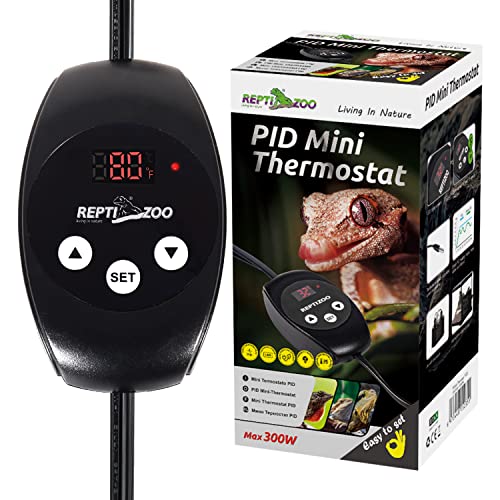
For dimming on a budget: REPTIZOO PID
A basking bulb that flickers, or an emitter you want feathered, needs proportional control rather than on/off. The REPTIZOO PID is the cheap Amazon route to that, and for a lot of keepers running a deep heat projector it's the right buy.
Be honest with yourself about the stakes, though. Keepers are split on this unit. Plenty run them for years without issue, but there are real failure reports, and the community's firm advice is not to trust any sub-hundred-dollar thermostat alone on something mission-critical. Incubating eggs, or a delicate species? Back it with a cheap on/off thermostat as a failsafe, or spend up to a Herpstat. Our full take is in the REPTIZOO review linked below.
What experienced keepers run: Herpstat (not on Amazon)
Ask experienced keepers what thermostat to run and the answer is a Herpstat, and it isn't close. It's made by Spyder Robotics and sold direct rather than through Amazon, so you'll order it from them rather than with Prime. It's still the right call for a lot of people, so here it is.
What stands out in keeper reports isn't enthusiasm. It's the absence of drama. People describe running the same unit for a decade or more and never thinking about it again. One keeper put it as "I've used Spyder Robotics Herpstats exclusively for 18 years and never had an issue." Another: "Herpstats are the Cadillac." A third, asked for a North American recommendation: "it's begins and ends with Herpstat." The practical draw is that a Herpstat does both dimming and pulse proportional control in one box, drives multiple heat sources on separate probes depending on model, and comes from an owner the community repeatedly describes as answering emails personally.
Vivarium Electronics is the other name that comes up, always framed as the runner-up ("VE is next best"). Both cost multiples of an Inkbird. What decides it is what's inside the enclosure. For a single mat under a hardy, established animal, an ITC-308 is enough, and we'd rather you put the difference into the enclosure. For a rack of animals, a breeding project, a bright basking bulb you want feathered, or an animal you'd be gutted to lose, this is the tier that stops the question from ever coming up again. Keepers also note that Herpstats turn up used at local shops and expos, which takes the edge off the price. One warning from those same threads: never run a splitter off a Herpstat to drive two heaters from one outlet. It modulates the whole outlet by one probe, so nothing lands at the right temperature, and keepers report enclosure fires from exactly this.
Also considered: WILLHI WH2408
The current WILLHI controller is a cheaper single-outlet on/off unit that does the same core job with fewer refinements. Nothing wrong with it. It comes down to a few dollars and brand preference against the Inkbird.
Mistakes worth avoiding
- Running any heat mat or ceramic emitter without a thermostat. This is the one that hurts animals.
- Letting the probe dangle in the air instead of taping it to the surface you're measuring.
- Burying a mat probe under thick substrate, which insulates the mat and lets it overheat.
- Putting a bright basking bulb on an on/off thermostat and living with the flicker, instead of using a dimming unit or managing the bulb by wattage and height.
- Trusting the thermostat display alone. Check it against a separate thermometer or a temp gun.
What we'd buy
The Inkbird ITC-308, unless you have a specific reason not to. BN-LINK if money is tight. The WiFi version if you want alerts. A dimming unit if you're incubating or running a basking bulb. Past your first animal, keeping a rack, or just done thinking about this? Buy a Herpstat and stop reading articles like this one. Any of them beats the alternative, which is a heater with nothing standing between it and your animal.
Recommended
Products related to this guide.



What owners say
Real owner reports from the threads and editorial sources we drew on for this guide.
“The Inkbird and ZooMed is a on/off thermostat what you need for a day bulb would be a pulse proportional or dimming thermostat. cough Herpstat. An on/off thermostat would reduce the life of a bulb drastically and it would drive you nuts seeing the bulb turn on and off constantly. I'm not sure how this works for a CHE though. Never use any heat source for reptiles without a thermostat as it can lead to burns and house fires.”
— r/snakes / Quantum15
“While this is generally correct just make sure if your heating element requires a dimming or pulsing thermostat. The advantage of a herpstat is its both types.”
— r/reptiles / TheLindoBrand
“I got the other one and I don’t like it because it shuts off completely then cut itself back on so you might like the dimming one”
— r/reptiles / One_Dance_3998
“I use the inkbird version of that rn. Trying to get one with a dimming feature”
— r/reptiles / SawzallGutsfuck
“If you're in North America, it's begins and ends with Herpstat.”
— r/snakes / shrike1978
“Herpstats are the Cadillac. VE is next best. Check any local shops for used Herpstats. You can often find them used.”
— r/ballpython / ConfidentTrip7
“Spyder Robotics is the gold standard that will last forever Vicarious is okay too”
— r/ballpython / secslop
“I’ve used Spyder Robotics Herpstats exclusively for 18 years and never had an issue.”
— r/reptiles / Milgram37
“I'll second the recommendation for a Herpstat. I upgraded to a Herpstat 2 Spyderweb a few years ago (from a Herpstat 1) and love it. Plus the owner is a very nice guy who will happily answer any questions you ask.”
— r/reptiles / bmac92
“Just buy one from Amazon for half the price. Pretty much any thermostat with a probe will work, you don't need to pay for the branding.”
— r/reptiles / savecaptainalex
“Not in Canada so I can't really give too much advice on this but have you tried going to any Reptile Expos or such to see if you can find something more reliable and more well known like a HerpStat of Vivaium Electronics?”
— r/reptiles / Jacqyn
“The bins melting sounds like a combination of bad heat tape and the thermostat not working properly. I would recomend getting a thermostat like the Herpstat or VE thermostat.”
— MorphMarket Community / logar