Best Chameleon UVB: Which Tube, How Strong, and How Far Away
By ReptileGearLab · Updated July 2026
Quick Take
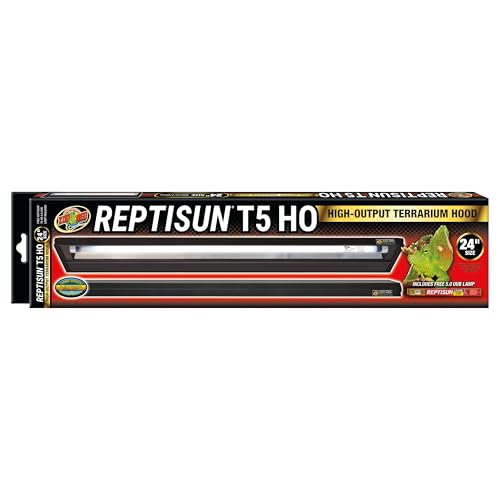
Buy a linear T5 HO tube in 6% (Arcadia) or 5.0 (Zoo Med), mount it on top of the screen, and put the highest basking branch 8 to 12 inches below it. That's what we'd buy and hang. Two things make this the one piece of chameleon gear worth getting exactly right: the coil-shaped "compact" UVB bulbs sold with chameleon pictures on the box are linked to eye damage, and the stronger 10.0 and 12% desert tubes are strong enough to burn a chameleon's eyes at normal distances.
Screen mesh eats roughly 30 to 40 percent of the output, which is already baked into those distances, so mount above the mesh and don't try to compensate by moving the tube closer. Glass blocks UVB completely. The UVB tube is also not a heat source. It barely gets warm. Your basking heat comes from a separate bulb, and the two do different jobs.
Tubes fade before they die, so replace yours every 6 to 12 months whether or not it still lights. Here's what we'd buy: See picks ↓
UVB is where chameleon keeping gets unforgiving. Too little and you get metabolic bone disease. Too much, or the wrong shape of bulb, and you get eye damage. The gap between those two is wide enough to be easy, but only if you buy the right tube and hang it at the right height, and the pet-store shelf is full of products that fail on both counts.
This is scoped to veiled and panther chameleons, the two species most people keep. Montane species like Jackson's want cooler, damper conditions and their own care sheet.
Linear tube, never a coil
The bulb has to be a long straight tube, T5 HO or T8, running across the top of the screen. Not the little spiral compact that screws into a dome. Keepers are blunt about this because the compacts have a track record: they've been linked to photokeratitis, the eye inflammation that makes a chameleon sit with its eyes closed, and the standard advice when someone posts a photo of one is to replace it immediately, whatever animal is pictured on the box.
The other reason for a tube is coverage. A chameleon needs to choose its own exposure, moving up toward the light and back down into shade through the day. A single point source lights one spot. A tube running most of the cage width gives your animal a gradient it can move along.
6% or 5.0, and no stronger
For veiled and panther chameleons, buy 6% if you're going Arcadia or 5.0 if you're going Zoo Med. They're roughly equivalent. Skip the 10.0, the 12%, and the 14% Dragon tubes: those are desert-species output, they're named repeatedly as an eye-burn risk for chameleons, and the extra strength buys you nothing your animal wants.
If you already own a tube and can't remember what it is, look at the endcap. Anything unmarked is worth replacing rather than guessing, because you cannot judge UV output by eye or by how bright the cage looks. Pair it with a proper screen enclosure, since glass blocks UVB entirely and a glass tank changes this whole calculation.
The T8 camp, stated plainly
We've recommended T5 HO, but a sizeable and knowledgeable part of the chameleon community prefers T8 5.0, and they have a fair case. T8 is weaker, which means it can sit closer and sits more forgivingly straight on top of the screen, and several long-time keepers call it their default for exactly that reason. The counter-argument, and the reason we land on T5, is that T5 punches through mesh better and T8 availability has been getting patchy. Either is defensible. What matters is that the distances differ: the 8 to 12 inch figure below is for a 6% or 5.0 T5 over mesh. If you run a T8, it needs to be closer than that, not further, or you'll under-dose toward metabolic bone disease.
Distance: 8 to 12 inches to the animal, not the branch
Mount the fixture above the screen and keep 8 to 12 inches between the tube and the top of your chameleon when it's basking. Measure to the animal, not the perch: an adult veiled's casque adds roughly three inches, and keepers point to unaccounted casque height as a common cause of burns. So a perch 8 inches down can put a big male's head at 5 inches. Add about three inches to your perch distance for an adult and you're in the right place. The range assumes mesh in the way, which costs roughly 30 to 40 percent of the output. We'd start at 10 inches to the animal and adjust.
Closer is where the trouble is. The failure mode is a branch or vine that lets the animal climb up near the tube, so check the cage from your chameleon's point of view, not from outside the mesh. If it can get its head within a few inches of the fixture you have two options, and lowering the branch is only one of them: plenty of keepers instead sit the fixture on blocks a few inches above the screen, which buys distance without giving up the top of the cage. Offsetting the tube to one side rather than centring it also helps, since it lets the light reach the animal's flanks and leaves a shaded side to retreat to. If you have a Solarmeter, aim for about 2 to 3 UV index where the animal sits. Metered readings at these heights usually land between roughly 1.7 and 2.6, which is right. Never move the tube closer than the distance floor to chase a higher number, because that is exactly how animals get burned. Without a meter, follow the distance and don't improvise.
The UVB tube is not your heat source
Put your hand under a T5 and you'll barely feel it, and that surprises people who assume one fixture does both jobs. It doesn't. UVB drives vitamin D3 synthesis so your chameleon can use calcium; warmth for digestion comes from a separate basking bulb over the same end of the cage. Run both. Veileds and panthers generally want a basking spot in the low-to-mid 80s F, and panthers on the cooler side of that. Don't try to fix a cold cage by moving the UVB closer.
Replace it before it dies
Fluorescent UVB output drops off well before the tube stops lighting, so a bulb that looks fine can be doing very little. Manufacturers say 12 months; plenty of keepers swap at 6, and some go sooner. We'd put a piece of tape on the fixture with the install date and replace between 6 and 12 months. Some keepers go as short as 6 on principle. A meter is the only way to know for sure, though it costs several times the tube and experienced keepers are split on whether it's worth it, with some saying they don't fully trust their own readings. Buying used is common.
Worth knowing before you shop: a bare replacement tube often costs nearly as much as a whole fixture-plus-bulb kit. If you're starting out, buy the kit. If you already own a good hood, just buy the tube and ignore the pricing weirdness.
What we'd buy
For a standard 24 by 24 by 48 cage: a T5 HO fixture with a 5.0 tube, sat above the screen, with the animal's head about 10 inches below it when basking. A separate basking bulb for heat. The install date written on the fixture in marker. It's a cheap setup to maintain and it's what we'd run.
Recommended
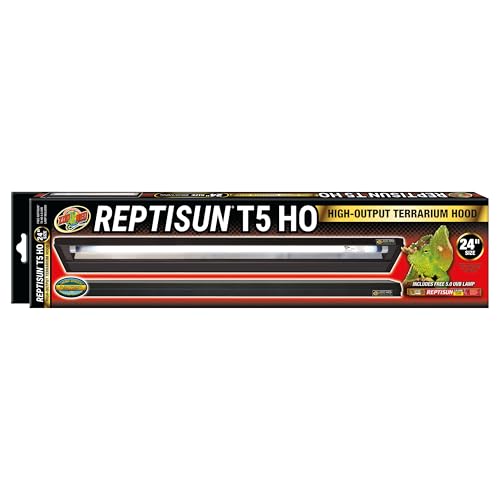
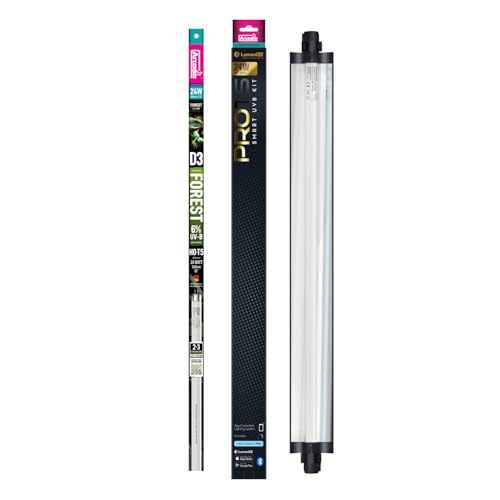
Products related to this guide.

What owners say
Real owner reports from the threads and editorial sources we drew on for this guide.
“The little compact bulb is not safe for chameleons. Just because there’s a chameleon on the book doesn’t mean anything. Suchhhhhh a bad way to determine if something is good or not.”
— r/Chameleons / justcallmekoko
“What I could find about UV lighting and problems with Chameleons, was the aforementioned 10.0 Desert Bulbs causing UV burn/Eye Problems, CFL 'Coil' from Exo Terra and Zoo Med Bulbs causing Photokeratitis in some cases (Again, mostly due to human husbandry error) but nothing noting T5HO could result in injuries to my Chams.”
— r/Chameleons / DarkBushido21
“Hey, the 12% is way to powerful and will burn there eyes. I am sure in an earlier post you said you have a 6%?”
— r/Chameleons / aussie_mallorca
“For chameleon don’t you want to use the Arcadia T5 UVB 6% not the 12%? Isn’t the 12% for “desert”?”
— r/Chameleons / HealthResearch12
“Usually around 30 - 40% reduction. I use a T5 6% . At 7 inches from the top my solarmeter reads about a 2.6 uvi directly under. I usually keep my basking spot between 8 and 6 inches perpendicular to the uv so it creates a gradient.”
— r/Chameleons / Fliggledipp
“I'm new here, so I'm sure someone more experienced will pipe in. But personally, I've used the T5 HO bulbs for approximately 2.5 years with no problems. It is approximately 8-9 inches above the highest perch, and my cham hasn't had any burns.”
— r/Chameleons / delphinapterus
“It’s around 8-12”. I have my branches lower because my first chameleon got burns just a little higher up.”
— r/Chameleons / Accomplished-Sea-687
“Understand. I do recommend getting a solarmeter 6.5 or 6.5r (same model just diff stickers) I got mine used.”
— r/Chameleons / Capoko
“If you haven’t already you should really get a new UVB, they only last about 3-6 months”
— r/Chameleons / bmuffle
“Who said that the UVb source was intended to produce heat? Their job is to produce UVb light at the proper levels for your animal to synthesize vitaminD3 among other functions”
— r/Chameleons / flip69
“You need a linear UVB which I cannot see. Needs a tonne of plants and a lot of horizontal branches for walking on.”
— r/Chameleons / nnynny101
“Use a 22 inch t8 5.0 or t5 5.0 in a 24 inch t8 or t5 hood depending on the bulb you buy. Also for heat use a 75w incandescent frosted white”
— r/Chameleons / JaBu_Smash