Do You Need Night Heat? (and what to use if you do)
By ReptileGearLab · Updated July 2026
Quick Take
Probably not. For most homes the answer is no night heat at all. A temperature drop after dark is normal and healthy for reptiles, and an ordinary heated house rarely falls below the point where it becomes a problem. Plenty of keepers run nothing at night, their animals sleep better for it, and the drop is what happens in the wild anyway. Before you buy a heater, measure what your enclosure does overnight.
The number you're measuring against is species-specific, and that's the part the internet gets wrong. There's no single safe floor for all reptiles. For a bearded dragon, we'd add night heat only if the enclosure consistently drops below 55F; dragons handle dips to 50F without ill effect. For a leopard gecko, 60F is the floor. Humidity-loving tropical species sit higher still. If your overnight low does fall under your species' floor, the fix we'd choose is a lightless heater, a ceramic emitter, a deep heat projector, or a radiant panel, on a thermostat. Never a red or coloured bulb.
Below: how to measure your overnight low properly, the floors keepers name, and the lightless heaters worth buying if the measurement says you need one. See picks ↓

"Do I need heat at night?" is one of the most-asked beginner questions in reptile keeping, and one of the few where the community answer is close to unanimous. Most of the time, no. Night heat gets bought defensively, out of worry rather than measurement, and a lot of it ends up in a drawer once the keeper learns what their room does after dark.
"Usually no" isn't "never," though, and the wrong kind of night heat causes real harm. So work in this order: understand why the drop is fine, measure your own overnight low, compare it against your species' floor rather than a number you read about a different animal, and only then decide whether to buy anything. If you do need something, one category is correct, and it isn't the red bulb in the pet-store heat aisle.
The honest answer: most setups need nothing
Reptiles aren't tropical fish sitting in a fixed temperature. In the wild almost every commonly kept species gets a substantial drop after sunset, including the desert animals people assume need warmth most. Keepers describe the drop as beneficial rather than merely survivable: it slows the animal down for a proper night's sleep, and several report it seems to sharpen basking behaviour the next day. One long-time bearded dragon keeper sums it up in three sentences: they live in the desert, it gets cold at night, and no heat at night has always worked fine.
That isn't just forum folklore. The care resources keepers rely on, ReptiFiles among them, say the same thing directly: nightly temperature drops are healthier than providing heat at night. So the burden of proof sits with the heater, not with going without one.
The practical version is that a normal heated home already sits above most species' night floors. Keepers with houses that hold in the low 70s F run nothing after dark. Keepers whose rooms drop into the 60s F usually run nothing either. The purchases that turn out to be necessary are the ones in cold rooms, unheated garages and conservatories, or old houses in winter, and those keepers know it because they measured rather than guessed.
There's a quieter reason not to buy by default. Every heater is a device that can fail on, and every extra device is another thermostat, another probe, another thing to check. Not needing one is an advantage, not a compromise.
Measure your overnight low before you buy anything
People skip this step, and it's the one that answers the question. What matters isn't what your thermostat says the house is set to, or what the enclosure reads at 9pm. It's the coldest the inside of the enclosure gets in the coldest hour of the night, in the coldest week of the year.
How to get that number:
- Use a logging thermometer, not a spot reading. A cheap Bluetooth hygrometer/thermometer that records a min and max is the right tool, because it captures the 4am low you were asleep for. A dial gauge stuck to the glass tells you nothing about last night.
- Put the probe where the animal is. Cool side, at animal level, not up near the lamp fixture and not on the warm side. You're measuring the coldest place the animal can be, which is the number that decides the question.
- Log for at least a few nights, ideally a cold snap. One mild night proves nothing about February. If you're asking this question in summer, the honest answer may be "not now, ask again in winter."
- Turn the daytime heat off first. Your basking lamp should already be on a timer and off at night. Measure the enclosure as it will be, unheated, not with a lamp still running.
Then compare that logged low against your species' floor. Above it, you're done, and you can stop shopping. Below it, keep reading. A reptile hygrometer handles the logging side, and an infrared temp gun is worth having anyway for spot-checking surfaces once a heater is installed.
The floor is species-specific (there is no universal number)
This is where most advice goes wrong. People quote a single temperature as though it applied to every reptile, and it doesn't. A desert lizard and a rainforest gecko have nothing in common here. What keepers give is a per-species floor:
- Bearded dragons: the coldest-tolerant of the common pets. Add night heat only if the enclosure consistently drops below 55F. Dragons handle dips to 50F without ill effect, which is why keepers report homes falling into the 50s all winter with no night heat and no problems. Their wild habitat gets colder still.
- Leopard geckos: 60F is the floor, and it's a firm one. Some keepers err warm inside the zone and add heat if the room heads under 65F, but that's preference rather than a published threshold. Note it sits above a bearded dragon's line despite both being arid animals, which is why you can't borrow one species' number for another.
- Humidity-loving and tropical species: higher again. Ball pythons, crested geckos and rainforest species are held to warmer overnight minimums, and for these the choice of heater changes too, because drying the air out is its own welfare problem.
Two things follow. Look up the floor for your species specifically, and treat any advice that gives one number for "reptiles" as unreliable. And notice that even experienced keepers of the same species name slightly different numbers, which tells you the floor is a zone rather than a cliff edge. A night that dips a degree or two below isn't an emergency. A room that sits well under the floor every night for months is.
One more caveat worth taking seriously, from a keeper who was talking themselves out of a purchase and then back into it: an animal surviving a temperature isn't the same as being comfortable at it. Where you land inside the zone is a judgement call, and erring warm inside the species range is defensible. Erring by adding light isn't.
If you do need it, the heat has to be lightless
Say the measurement came back cold and you do need supplemental heat. The rule: at night, heat with no visible light. Three tools do that, and they differ mainly in price, humidity behaviour, and how they mount.
- Ceramic heat emitter (CHE): the cheap, common answer. A screw-in ceramic element that gets hot and gives off no light at all, in a standard ceramic dome fixture. It's supplemental heat rather than a basking source, and its one real drawback is that it dries the air, which matters a lot for humidity species and not at all for arid ones. Full detail in our ceramic heat emitter review.
- Deep heat projector (DHP): the upgrade, at about 60 percent more than a budget CHE two-pack, or roughly triple per bulb. Also lightless, but it dries the air far less, which is why keepers steer ball python and crested gecko owners to it. Arcadia recommends a dimming thermostat for theirs. See our Arcadia deep heat projector review.
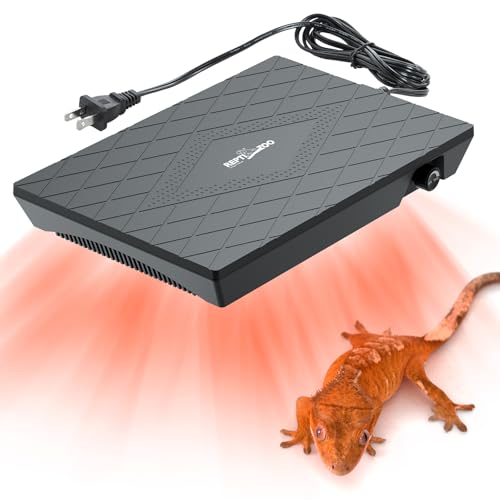
- Radiant heat panel (RHP): a flat panel that bolts to the ceiling of the enclosure and radiates gentle heat downward, with no exposed glowing element to touch. It needs a solid top to mount to, so it suits PVC enclosures rather than screen-topped glass tanks. The panel keepers rate highest is sold direct rather than on Amazon, covered in our Reptile Basics radiant heat panel review.
Not on this list: heat mats as a night-heat answer. Keepers routinely tell people not to reach for one here, and the reasoning is in our leopard gecko heat mat guide. Also not on the list: leaving the daytime basking bulb running. A basking lamp is bright by design, because reptiles find a basking spot by brightness, and running it overnight cancels the night cycle you were trying to protect.
Skip the red and coloured bulbs
The red night bulb is still stocked in every pet store, and the box says reptiles can't see red, so it heats without disturbing sleep. Modern keeper consensus is that the premise is wrong, and the mainstream care resources agree: reptiles do see the light from these bulbs, and it can disrupt their sleep and wake cycle. Not the way we see it, but well enough that a red glow running all night reads as light, and the community treats coloured night lighting as something to retire rather than buy. Newcomers arrive at forums having been sold one, and get talked out of it with striking consistency.
Be precise about the claim, because keepers themselves are. The strong version, that red light physically damages reptile eyes, is contested among keepers and this guide doesn't assert it. What nobody in the community argues about is the sleep and cycle disruption, and that alone rules the bulb out, since a lightless emitter does the same heating job for about the same money with no light at all.
Already own a red bulb? Keep it in the power-outage box and stop running it overnight. Our Zoo Med Nocturnal Infrared Heat Lamp review covers what keepers report when they switch away from one, and why "cheap heat" stops being cheap once you count what it costs the animal's night.
Everything runs on a thermostat
No night heater goes straight into the wall. A heat source with nothing regulating it has one setting, full power, and it keeps climbing until something stops it. The controller isn't an accessory to add later. It's part of the purchase.
Which type depends on what you bought. A CHE and a radiant panel emit no visible light, so a simple on/off thermostat is a correct match for them: there's no bulb to blink when the unit cycles. A DHP is different, in that Arcadia recommends a dimming thermostat for its deep heat projector, which eases the power up and down rather than slamming it and gives more accurate control of the gradient. Keepers note an on/off unit won't endanger the animal or destroy a DHP, but treat it as a stopgap rather than the setup you settle on.
A knob on the side of a heater is not a thermostat. Panels and plates that ship with an onboard dial control how much power the unit puts out, not what temperature the enclosure reaches, because nothing is reading the enclosure. Only a probe sitting in the enclosure and cutting the power can do that, which is why the controller stays on the shopping list even when the heater has its own dial.
Set the probe where it regulates the heat, not dangling where the animal can lie on it, and verify the real temperature with a separate thermometer rather than trusting the display. Our reptile thermostat guide covers choosing between the on/off and dimming units, and which ones are worth a failsafe.
Guards, clearance, and the boring safety part
Lightless heaters run hot and don't look it, which is exactly the problem. Mount a ceramic emitter above the screen top, in a ceramic-socket wire-cage fixture, so the animal can't reach it. Zoo Med's own instructions are emphatic that you should never mount a ceramic heat emitter inside an enclosure, calling it a serious fire and burn hazard. Outside and above, never in with the animal. The same sheet adds a detail people miss: a radiant heat source like a lamp or an emitter shouldn't sit above a glass cover, which the heat can fracture. Never let the emitter touch or rest against anything either: no plastic sockets, no other fixtures, no substrate, no decor.
The same discipline applies across the category. Use a ceramic-socket fixture rated for the wattage, never a plastic one. Give a radiant panel the clearance its manufacturer specifies between the panel face and any shelf or surface, and bolt it to a solid ceiling properly, because a panel coming loose is a heavy thing falling on an animal. Keep cables away from anything hot, which is a real risk with the insulation tricks keepers use in cold rooms, such as foam board on the outside of a tank and foil on top that must not touch a light fixture.
One last habit: put the heater on its own thermostat rather than sharing a controller with the daytime lamp, and check the overnight readings again a week after installing it. You added night heat to hold a floor. Reading the numbers is how you know it's holding.
Where we land
Start from "no." A night-time temperature drop is natural and beneficial, and most homes never fall below the point where it matters. Log your enclosure's overnight low at animal level for a few cold nights, look up your own species' floor rather than a number written about someone else's animal, and compare the two. That measurement answers the question, not a forum vibe and not a pet-store upsell.
If it does come back cold, buy in this order: a lightless heater sized to the job, a thermostat to run it, and a guard or mounting that keeps the animal away from the hot part. A ceramic emitter for an arid species, a deep heat projector if humidity matters, a radiant panel if you have a solid-topped enclosure. And whatever you do, no red bulbs, and no light of any colour after dark.
Recommended
Products related to this guide.




What owners say
Real owner reports from the threads and editorial sources we drew on for this guide.
“my room stays at 21 C at night because i get cold easily, so no heat on at night for the dragon. additionally, it gets quite cold at night in the wild for them, the cold helps slow them down and get a good night sleep. unless your home gets to like 15C or lower consistently at night, no you dont need heat at night”
— r/BeardedDragons / spaceinbird
“unless temp is going below 50F you don't need any night heating. bearded dragons benefit from a drop of temperature at night time, it boosts their immune system, makes them sleep better and encourages more basking during daytime. our home consistently goes under 60F during winter, and we never ever used any night heating for our dragons, they have no issues with this temperature as long as your daytime temperature meets their needs.”
— r/BeardedDragons / SavageDroggo1126
“They live in the desert. It gets cold at night. No heat at night has always worked fine for my boy.”
— r/BeardedDragons / salted-n-burnt
“My house stays at 74F year round so I don’t use heat at night..when we first got her I had the emitter on because she was so small and seemed like she was cold..once she went to her new enclosure with soil, rocks, logs etc there didn’t appear to be any need as the temps seemed to replicate the ‘wild’ with the temp drop at night”
— r/BeardedDragons / Willing-Pineapple-32
“Why are you wanting to leave it on at night? They don’t need heat at night unless it’s staying below 60F in the room.”
— r/leopardgeckos / Pentavious-Jackson
“Just adding, don’t use a heat mat but the CHE or DHP are fine for nighttime heat if it’s getting under 65F at night. During the day the basking bulb should cover what you need. If not then you can try insulating the outside of the tank with styrofoam (sides and back) and foil on top but not touching any light fixtures.”
— r/leopardgeckos / LooseGuthix
“A lot of animals don't need much heat at night. For example, a bearded dragon (an animal that I know about, lol) are happy with no heat at night, going down to about 60f in captivity (and lower in their habitat). A ceramic heat emitter or deep heat projector are heat lamps that produce no light at night.”
— r/reptiles / _NotMitetechno_
“I have an albino milk snake who has a red heat light on 24/7. However, I recently read that snakes can see red and if the light is on it messes up their day/night cycle.”
— r/snakes / Dandylioncrush6303
“Ceramic heat emitters are not particularly good primary heat sources for reptiles. Incandescent lamps (with white light) are far superior. CHE's are only suitable as night heat or supplementary heat to increase ambient temperatures.”
— r/snakes / valdemarjoergensen
“I wanted a 24/7 heat source to ensure it doesn't get too cold at night, but I drop the temperature to 75. I've heard rosy boas can withstand lower temps as they're desert snakes, but I don't want the animal to be uncomfortable just because it can survive it.”
— r/snakes / _lynnyxe_