Zoo Med
Zoo Med Repti Calcium without D3 Reviews + The Everyday Duster Verdict
By ReptileGearLab · Updated August 2026

Verdict
The striking thing about the community conversation is what it isn't about: almost nobody argues over whether this powder is any good. No clumping complaints, no quality horror stories, no regret posts about the calcium itself. What keepers debate is the D3, and the consensus comes back clear and repeated: under working UVB an animal makes its own D3, so the everyday duster should be the version without dietary D3, with the with-D3 tub kept for low-UVB setups or the occasional scheduled feeding. Keepers describe the mechanism plainly, that UVB is what lets the body process calcium, and they warn just as plainly about the flip side, that dietary D3 is fat-soluble and can be overdosed when it stacks from a D3 calcium, a D3 multivitamin and UVB all at once. Their schedules vary in the details, some run plain calcium most feedings with a D3 product one day, some six days without and one with, but the shape is the same everywhere: without-D3 as the default and D3 as the occasional add. Read together, that puts Repti Calcium without D3 in the every-feeding slot for most UVB-lit setups, and we'd run it the same way. The mistake to avoid is grabbing the near-identical with-D3 tub by accident.
Read full take ↓Similar feeding supplies
Zoo Med Repti Calcium without D3 is the plainest, safest thing you can put in a reptile cabinet: a phosphorus-free calcium carbonate powder you dust onto feeder insects, with no vitamin D3, no multivitamin, no filler blended in. That "without D3" on the label isn't a downgrade. For any animal kept under proper UVB, it's the reason to buy this tub instead of its near-identical with-D3 twin. Across a big stack of keeper threads the powder itself is boring in the best way: nobody is fighting about clumping or quality, they're dusting bugs and moving on.
This version exists because D3 can be oversupplied and calcium can't, not in any way keepers worry about. Vitamin D3 is what lets the body use calcium, and an animal gets it two ways: from a UVB bulb, or from the diet. If your reptile has working UVB, it's already making its own D3, so piling more dietary D3 on top at every feeding is the one thing keepers consistently warn against. The without-D3 tub sidesteps that. It carries the calcium every reptile needs constantly, and leaves the D3 to the lighting that's already handling it.
So for most setups, the ones running a real UVB bulb, this is the calcium that belongs in the everyday rotation, and the with-D3 twin is the occasional or low-UVB tool rather than the reverse. It's cheap, it lasts for months, and it's clean enough that you decide the rest of the schedule instead of a blend deciding for you. Buy it as your default duster under good UVB and it does its one job without drama. The trap is the packaging: the two tubs look almost the same, so read the label twice.
The short version
What's good:
- Phosphorus-free calcium carbonate, the clean base a dusting schedule is built on, with nothing else stacked into it.
- No vitamin D3, so under working UVB you can dust at every feeding without stacking toward the D3 oversupply keepers warn about.
- Cheap, and a single tub lasts many months because a feeding only needs a light dusting.
- Widely used and quietly reliable: across a large pile of keeper threads, nobody complains about the powder itself.
What's not:
- In a setup with weak or no UVB, this alone won't supply the dietary D3 the animal needs to use calcium. That's the with-D3 tub's job.
- Calcium alone isn't a complete plan; you still need a multivitamin somewhere in the rotation for vitamin A and trace nutrients.
- The near-identical WITH-D3 and WITHOUT-D3 tubs are easy to grab wrong off a shelf.
- No frills at all, so if you'd rather one tub did everything, an all-in-one suits you better.
Which reptiles and setups it fits
Buy it for:
- Any setup with proper, maintained UVB. A working bulb already drives the animal to make its own D3, so the everyday duster should be the version without dietary D3 on top. This is the default for most keepers.
- A keeper who wants a plain calcium they can meter precisely, kept separate from their multivitamin, rather than a blended powder that sets the ratios for them.
- A free-choice calcium bowl, mainly a leopard-gecko practice. With no D3 in it, keepers are comfortable leaving this one out for nibbling in a way they aren't with the D3 tub. Bearded dragon keepers tend to dust rather than bowl.
Pick something else if:
- Your animal has little or no functional UVB. It then needs a dietary source of D3 to use calcium at all, and the with-D3 twin is the tub that carries it. Keepers reserve the D3 version for exactly this gap.
- You want a single tub that covers calcium, D3 and a full multivitamin. An all-in-one like Repashy Calcium Plus is the simpler path, though it already contains D3, so account for that in your lighting plan.
- You're building a complete schedule from scratch. Whichever calcium you land on, you'll still want a multivitamin alongside it for the vitamin A and trace nutrients calcium doesn't carry.
The specs that matter
For a powder the spec sheet is short, and what's on it decides the purchase.
- Phosphorus-free calcium carbonate. Feeder insects are naturally low in calcium and higher in phosphorus, and the body needs far more calcium than phosphorus to build bone. A phosphorus-free calcium tips that ratio back the right way, which is why you dust in the first place. This is a clean single-ingredient calcium, not a blend, and that's a feature.
- No vitamin D3, on purpose. D3 is what lets the body absorb the calcium you just dusted on, and UVB drives the animal to make its own. Under good UVB you don't need much dietary D3, and keepers warn that too much of it becomes its own problem. Leaving D3 out is what lets this tub be the everyday duster: the calcium goes on daily, the D3 comes from the light.
- Ultrafine dusting powder. A fine powder meant to cling to a feeder after a quick shake in a bag or cup. A light, even coat is the goal. A thick cake is wasteful and less likely to be eaten, and some keepers rinse or brush off the excess.
How it keeps your animal safe
Calcium matters because of metabolic bone disease. A reptile short on usable calcium pulls it from its own skeleton, and the result is soft bones, deformities and, far enough along, a dead animal. So the job of any calcium duster is to keep enough usable calcium going in that the body never has to raid itself. On that core job, plain phosphorus-free calcium carbonate is what you want, and this delivers it as cheaply and plainly as anything on the shelf.
Usable calcium means calcium plus a way to absorb it, and that way is D3. As one keeper explains the mechanism,
"Calcium without d3 bowl is recommended along with dusting feeders. Very simplified: uvb makes it so calcium can be processed in the body, without uvb a supplement of d3 is needed to help that process." That's the logic of the without-D3 tub. If UVB is doing the D3 job, dietary D3 is the part you don't want to keep adding, and the community rule keepers repeat is to make the without-D3 calcium the default under good lighting.
The failure mode keepers describe is stacking. Dietary D3 can arrive from a D3 calcium, from a multivitamin that already contains D3, and functionally from UVB, all at once, and keepers warn that piling all three on is how you drift toward oversupply. The without-D3 version removes one of those sources entirely, which is why it's the safer everyday default. To be clear about what this is: not our veterinary advice, but the consistent framing across keeper threads and care resources, and D3 dosing on an animal you're worried about is a conversation for a reptile vet. What the without-D3 tub does is give the keepers who run UVB a calcium they can dust freely without adding to a D3 load the light is already carrying. The one setup where it falls short is the flip side: with weak or no UVB, this alone won't supply the D3 the animal needs, and that's the job the with-D3 tub exists to do.
Build quality and living with it
There isn't much hardware to a tub of powder, and the reports reflect that. Across a large body of keeper threads there's no drumbeat of clumping complaints, no quality-control horror stories, no "my tub arrived caked solid." It's a fine, dry, ultrafine calcium that does what a calcium is supposed to do, and for a product this widely used, silence on defects counts as a mild vote of confidence. Store it dry with the lid sealed and it stays free-flowing. Moisture is the only enemy of a calcium powder, and it's what turns a fine dust sticky.
The one real living-with-it hazard is the packaging rather than the powder. The WITHOUT-D3 and WITH-D3 tubs look almost identical, same brand, same layout, a small line of text apart, and it's easy to buy or grab the wrong one on autopilot. If you deliberately run both, which is a reasonable schedule, mark the lids so a tired late-night dusting doesn't put D3 on a feeder that was supposed to get plain calcium, or leave plain calcium where you meant to give the scheduled D3. It's cheap and it lasts a long time, so keeping the tub you use less often on hand costs almost nothing.
How it compares
- Versus the with-D3 twin: the real cross-shop, not a competitor. Same powder, same price, and the only difference is the D3. Under proper UVB, this without-D3 version is the correct everyday duster and the with-D3 tub is the occasional top-up. In a low-UVB or UVB-free setup that flips, and the D3 version earns its place as the dietary D3 source. Most keepers with good lighting should own this tub as their default and reach for the D3 one on purpose.
- Versus Repashy Calcium Plus: the all-in-one path. Calcium Plus folds calcium, D3 and a full multivitamin into one tub, so you dust a single powder instead of running a plain calcium plus a separate vitamin. More convenient, harder to under-supplement, but it already carries D3, so under strong UVB many keepers would rather dust plain calcium most feedings and keep an all-in-one for the scheduled slot. Plain Repti Calcium wins when you want to control the pieces yourself.
- Versus Reptivite and Rep-Cal: worth clearing up, because the names blur. Reptivite is a multivitamin, not a calcium, and it comes in its own with-D3 and without-D3 versions, so it runs alongside this calcium rather than instead of it. Rep-Cal is a different brand's calcium. Zoo Med Repti Calcium without D3 is a plain calcium and nothing more, which is why it's normal to pair it with a multivitamin for the vitamin A and trace nutrients it doesn't carry.
Setting it up
Dusting is simple: drop feeder insects into a cup or bag with a small amount of powder, give it a gentle shake to leave a light even coat, and feed. You want a dusting, not a snowball, and if a feeder comes out caked it's fine to knock off the excess. Gut-loading the feeders first does more for nutrition than a heavy coat ever will.
The schedule is where the without-D3 tub earns its keep. Under solid UVB, keepers describe dusting with this plain calcium at most feedings and reaching for a dietary-D3 source only occasionally, if at all; the more reliable your UVB, the less dietary D3 you want. In a setup with weak or no UVB, the balance shifts and the with-D3 tub carries more of the load. Either way, run a multivitamin alongside this for the vitamin A and trace nutrients calcium leaves out, and check that the multivitamin's D3 status lines up with your plan rather than doubling up. Store it sealed and dry, and before you buy or dust, read the label twice: with-D3 and without-D3 sit one line apart.
Our call
As a plain, phosphorus-free calcium, this is a good and honest product, and the quiet is a compliment: keepers use it and don't think about it, which is what you want from a calcium. It's cheap, it lasts, and it's clean enough that you decide the rest of the schedule instead of a blend deciding for you.
For most setups, meaning most setups with working UVB, this without-D3 tub is the smarter everyday purchase and the one that belongs in daily rotation, with the with-D3 twin kept for sparing top-ups or for enclosures where the UVB is weak or absent. Match the variant to your lighting and this is a no-drama supplement that removes the thing keepers worry about, an accidental D3 overdose, by not having it in the tub. The only mistake it invites is the one the near-identical label makes too easy: grabbing the wrong twin.
Our Ratings
Overall score
Build quality for a supplement means powder consistency and packaging, and this is a fine, dry, phosphorus-free calcium carbonate that keepers use and forget about. A large body of reports surfaces no clumping or quality-control complaints, which for a product this widely used counts as a quiet endorsement. Moisture is the only enemy, since it turns any calcium dust sticky. The one real living-with-it hazard is the packaging rather than the powder: the WITHOUT-D3 and WITH-D3 tubs look almost identical and are easy to grab wrong, so mark the lids if you run both.
Safety and reliability is this version's strongest axis, and the without-D3 formulation is what earns it. As a phosphorus-free calcium the powder does the core MBD-prevention job cleanly, and leaving D3 out removes the thing keepers warn about most: an accidental dietary-D3 overdose stacked on UVB and a D3-bearing multivitamin. Under proper UVB this is the safe everyday default, dusted freely without adding to a D3 load the light already carries. It docks short of a top score for two reasons. It isn't a complete plan on its own, since a multivitamin still belongs in the rotation, and in a weak or no-UVB setup it won't supply the dietary D3 the animal then needs.
Value sits right up with safety. It's cheap, a single tub lasts many months because a feeding needs only a light dusting, and it's a clean single-ingredient calcium rather than a blend you pay extra for. It's also the correct everyday tub for most keepers, the ones running UVB, so unlike its with-D3 twin it earns its money in daily rotation rather than as an occasional tool. The one thing standing between you and that value is picking the right twin off a near-identical shelf.
Zoo Med Repti Calcium without D3 on Amazon.
The Evidence Behind Our Verdict
The striking thing about the community conversation is what it isn't about: almost nobody argues over whether this powder is any good. No clumping complaints, no quality horror stories, no regret posts about the calcium itself. What keepers debate is the D3, and the consensus comes back clear and repeated: under working UVB an animal makes its own D3, so the everyday duster should be the version without dietary D3, with the with-D3 tub kept for low-UVB setups or the occasional scheduled feeding.
Keepers describe the mechanism plainly, that UVB is what lets the body process calcium, and they warn just as plainly about the flip side, that dietary D3 is fat-soluble and can be overdosed when it stacks from a D3 calcium, a D3 multivitamin and UVB all at once. Their schedules vary in the details, some run plain calcium most feedings with a D3 product one day, some six days without and one with, but the shape is the same everywhere: without-D3 as the default and D3 as the occasional add. Read together, that puts Repti Calcium without D3 in the every-feeding slot for most UVB-lit setups, and we'd run it the same way.
The mistake to avoid is grabbing the near-identical with-D3 tub by accident.
Our rating above is our own editorial call. What follows is the field evidence we weighed to reach it: first-hand reports from keepers on Reddit and dedicated reptile forums, which we lean on more than manufacturer-influenced published reviews because unsponsored owners tend to be the more candid signal.
What Reddit Is Saying
“without D3. if you have proper T5HO UVB you should not need to supply D3 orally at all.”View thread →
“Both are good, use the normal calcium without D3 more often than the one with D3 assuming you have proper UVB lighting. Then the one with D3 can be used supplementarily.”View thread →
“Calcium without d3 bowl is recommended along with dusting feeders. Very simplified: uvb makes it so calcium can be processed in the body, without uvb a supplement of d3 is needed to help that process.”View thread →
“You still would use pangea/repashy, with the same amount of d3 in it even if your providing a uvb bulb. You would only change what your dusting your feeder insects with from calcium with d3, to calcium without d3.”View thread →
“Both. If u feed with vitamin d3 everyday they will get d3 poisoning . I recommend 6 days a week for without d3 calcium and on the seventh with d3 calcium. Or just invest in a uvb light and feed d3 calcium rarely”View thread →
“since D3 is fat soluble, they can overdose on it, also, they should be able to make all the D3 they need with appropriate UVB lighting, so going from that, and the fact that they need a decent amount of calcium, I think it's best to use calcium without D3”View thread →
“Just adding, you should also get the calcium without d3 (and the multivitamin that was mentioned). Can do a schedule like this (expand based on how often you feed)- 1- calcium with d3 2- multivitamin 3- calcium without d3 4- calcium with d3 So your calcium without d3 and multivitamin are both every 4 feedings and the calcium with d3 is your main. If you do get a UVB then reverse the calcium with/without d3 part but keep multivitamin the same.”View thread →
“some people who feed their leos multiple times a week will use regular calcium (without D3) for most feedings and then use the Calcium Plus on only one day.”View thread →
“Both! Always without D3 and every third or so with D3 at most. They can overdose on D3 and too much also causes bone and mobility issues.”View thread →
“Dragons don't need supplemental D3. It is best they get it via UVB.”View thread →
Frequently asked questions
Is the Zoo Med Repti Calcium without D3 worth it?
Value sits right up with safety. It's cheap, a single tub lasts many months because a feeding needs only a light dusting, and it's a clean single-ingredient calcium rather than a blend you pay extra for. It's also the correct everyday tub for most keepers, the ones running UVB, so unlike its with-D3 twin it earns its money in daily rotation rather than as an occasional tool.
How is the Zoo Med Repti Calcium without D3 built?
Build quality for a supplement means powder consistency and packaging, and this is a fine, dry, phosphorus-free calcium carbonate that keepers use and forget about. A large body of reports surfaces no clumping or quality-control complaints, which for a product this widely used counts as a quiet endorsement. Moisture is the only enemy, since it turns any calcium dust sticky.
Is the Zoo Med Repti Calcium without D3 safe to use?
Safety and reliability is this version's strongest axis, and the without-D3 formulation is what earns it. As a phosphorus-free calcium the powder does the core MBD-prevention job cleanly, and leaving D3 out removes the thing keepers warn about most: an accidental dietary-D3 overdose stacked on UVB and a D3-bearing multivitamin. Under proper UVB this is the safe everyday default, dusted freely without adding to a D3 load the light already carries.
What do real owners say about the Zoo Med Repti Calcium without D3?
The striking thing about the community conversation is what it isn't about: almost nobody argues over whether this powder is any good. No clumping complaints, no quality horror stories, no regret posts about the calcium itself. What keepers debate is the D3, and the consensus comes back clear and repeated: under working UVB an animal makes its own D3, so the everyday duster should be the version without dietary D3, with the with-D3 tub kept for low-UVB setups or the occasional scheduled feeding.
Options Worth Checking Out

Zoo Med Repti Calcium with D3
The scheduled partner to this everyday tub. Same phosphorus-free calcium, plus the vitamin D3 a weak or missing UVB bulb can't provide. Keep it for low-UVB setups or the occasional dietary-D3 feeding, not as your daily duster under strong lighting.
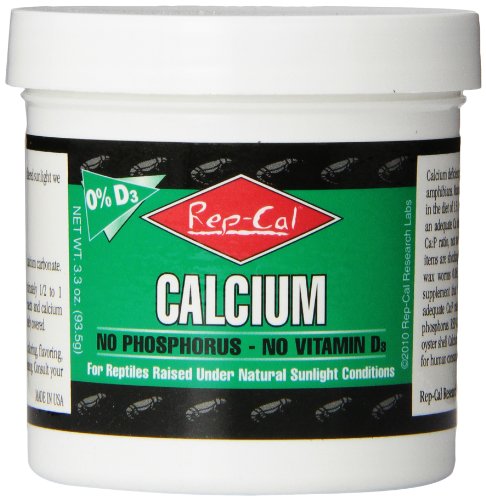
Rep-Cal Phosphorus-Free Calcium (ultrafine)
The other keeper-default plain calcium, an ultrafine phosphorus-free powder that clings to feeders well. Same job as the Zoo Med, no D3 or phosphorus, so it is for UVB setups dusted most feedings. Only one grind; some find it dustier.
You Might Also Need
Accessories worth grabbing alongside your purchase

Zoo Med Reptivite with D3
The Zoo Med multivitamin that fills in the vitamin A and trace nutrients a plain calcium leaves out. This is the with-D3 version, so treat it as your scheduled dietary-D3 slot and dust plain calcium the rest of the time to keep the D3 from stacking.

Arcadia EarthPro-A Multivitamin
A vitamin-forward, D3-free multivitamin that pairs cleanly with this plain calcium on non-D3 days under UVB. It covers the vitamin A and trace nutrients a straight calcium can't, without adding to a dietary-D3 load your lighting already carries.