Zoo Med
Zoo Med ReptiSun T5 HO 5.0 Review (Low-UV Species)
By ReptileGearLab · Updated October 2026
Verdict
Keepers treat the linear ReptiSun 5.0 as a correct, unremarkable choice, and most of the discussion around it is not about whether it works but about making sure you buy the right thing. It is named directly as a good option for leopard geckos, with the useful addition that it suits albinos too provided the distance from the basking area is increased rather than the lamp being downgraded. Crested gecko keepers report mounting it straight onto the mesh, which is one of the practical benefits of a low-output tube. The strongest and most repeated advice concerns form factor rather than brand: get the linear tube, not a compact. Keepers describe compact bulbs as dangerous on the grounds that their output is uneven and unreliable and can lead to UV burns, and that warning is given without hedging. This matters because the ReptiSun 5.0 name covers a compact mini as well, and at least one crested gecko keeper bought that version with a compact top before learning they would need to raise it to avoid burning the animal. Strength confusion is the other recurring theme, with keepers identifying the correct low-output box by its chameleon artwork as opposed to the bearded dragon artwork on the 10.0. The competing recommendation throughout is Arcadia's ShadeDweller, which comes up repeatedly as the purpose-built option for shade-dwelling species, and at least one keeper moved to Arcadia after starting down the ReptiSun route, though without saying which they rated higher. Read together, the linear fixture is well regarded and correctly specified for low-UV animals, while the criticism attaches to the confusing product family around it and to a rival that specialises where this lamp generalises.
Read full take ↓Similar UVB bulbs
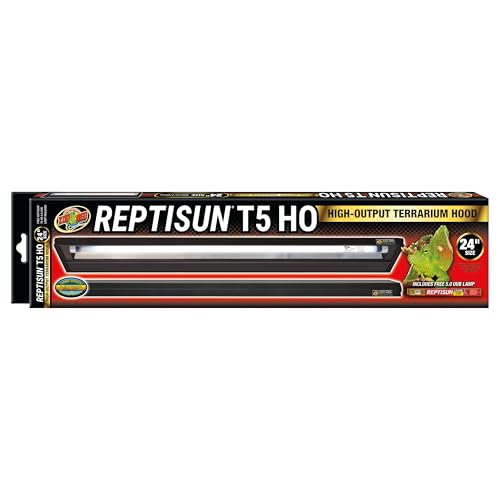
The ReptiSun T5 HO 5.0 is the low-output half of Zoo Med's UVB line, and it is the one you want for a leopard gecko, a crested gecko, a ball python, or anything else that lives in shade rather than open sun. Our review of the 10.0 covers the bearded dragon end of the range. This is the other end, and getting the two straight is most of the buying decision.
As a product it is straightforward and good. A linear T5 HO tube in a reflective hood puts out an even, predictable band of UVB across the length of the fixture, which is exactly what a low-UV animal needs and exactly what the cheap alternatives fail to do. Keepers name it consistently as a correct choice for Zone 1 species, and it is a pick in three of our own guides.
The complication is the name. Zoo Med also sells a compact, screw-in "ReptiSun 5.0" mini, and keepers are blunt about compacts producing uneven output and causing UVB burns. Same brand, same number on the box, very different product. This review is about the linear T5 HO fixture, and a good part of its job is making sure you buy that one.
The short version
What's good:
- A linear T5 HO tube, which is the form factor that matters. Even output along the length of the fixture instead of a hot spot of concentrated UV.
- 5.0 is the correct strength band for Ferguson Zone 1 and Zone 2 animals: leopard geckos, crested geckos, ball pythons and other shade-dwellers, and it also serves chameleons at the greater distances a tall mesh enclosure imposes.
- Forgiving to mount. At this output it can sit on the mesh of a screen top rather than needing to be suspended at a careful distance.
- Works for sensitive animals, including albino leopard geckos, provided you adjust the distance from the basking area.
- Sold as a hood and bulb together, so it is a complete fixture rather than a bulb you then have to find a home for.
What's not:
- The naming is a real hazard. "ReptiSun 5.0" also names a compact CFL, and keepers warn that compacts have uneven, unreliable output and have caused UVB burns. Different product, same number.
- The 5.0 and 10.0 boxes are easy to confuse. Keepers navigate by artwork, the chameleon box rather than the bearded dragon box, which tells you how unclear the labelling is.
- Arcadia's ShadeDweller is the common alternative for Zone 1 and keepers do switch to it, sometimes after buying this first.
- The bulb needs replacing roughly annually even though it still lights, so the sticker price is not the running cost.
Why the 5.0 and not the 10.0
UVB is dosed, not just supplied. Reptiles are grouped into Ferguson zones by how much ultraviolet they seek in the wild, and a leopard gecko or crested gecko sits at the bottom of that scale. Giving a shade-dwelling animal a desert-strength lamp is not a bigger favour; it is an overexposure risk, and it is the single most common UVB mistake we see. Our leopard gecko UVB guide and ball python UVB guide both land on a low-output lamp for exactly this reason.
That is the whole case for the 5.0. It produces a gentle band of UVB that lets a low-UV animal make its own vitamin D without pushing it past what it would ever meet at dawn or dusk in the wild. Keepers recommending it for leopard geckos add a useful detail: it suits even albinos, which are more light-sensitive, as long as you increase the distance from the basking spot rather than reaching for a weaker lamp.
One species note, because it is easy to misread this lamp as Zone 1 only. Chameleons need more UV than a leopard gecko, and this same fixture is our top pick for them, which works because a chameleon is usually kept in a tall mesh enclosure where screen loss and basking distance cut the delivered dose substantially. Same tube, different geometry, higher target. That is also why the box carries chameleon artwork. If you are setting one up for a chameleon rather than a gecko, follow the mounting distances in our chameleon UVB guide rather than the Zone 1 advice here.
Linear versus compact: the part that decides it
If you take one thing from this review, take this. A linear T5 tube spreads its output evenly across the fixture, so the animal meets a broad, low band of UV that it can move through. A compact or coil bulb concentrates output from a small source, and keepers describe that output as uneven and unreliable, with a documented history of UV burns to the eyes and skin. The advice in keeper threads is consistent and unhesitating: get the linear one.
This matters here because Zoo Med sells both under the ReptiSun 5.0 name, and a keeper searching that phrase can easily end up with a compact mini in a small hood. One crested gecko keeper bought exactly that combination, then discovered while reading up afterwards that they needed to raise the fixture away from the enclosure or risk burning the animal, and ended up switching brands entirely. None of that is a defect in the linear fixture reviewed here. It is a reason to look carefully at what you are adding to the basket.
The second confusion is strength. The 5.0 and 10.0 packaging is similar enough that keepers navigate by the artwork, describing the correct low-output box as the one with the chameleon rather than the one with the bearded dragon. That works, but it is not a great sign that this is how buyers tell a Zone 1 lamp from a Zone 3 one.
One more trap in this product line: the 5.0 figure is the share of output that is UVB, not how much of it there is. So a T5 HO 5.0 and a T8 5.0 are not interchangeable despite the matching number. The T5 is substantially the stronger lamp and has to sit further from the animal, or be run over a longer distance and more shade, to land in the same place. Keepers who move from a T8 fixture to a T5 and keep the same mounting height can quietly overexpose an animal while believing nothing changed, which is the inverse of the coil problem and just as easy to miss.
Zoo Med also sells this as a combined LED and UVB hood, which keepers with planted enclosures tend to like for the obvious reason that it solves UVB and visible light in one fixture. If your enclosure has live plants in it, that version is worth a look before you buy a UVB tube and a separate light bar.
Mounting and running it
- Screen mounting is fine at this output. A 5.0 can sit directly on the mesh, which is one of the practical advantages of a low-output lamp. Mesh does absorb a share of the UV, and that is already accounted for at this strength.
- Increase distance for sensitive animals. For albinos or any animal that avoids light, raise the fixture rather than dropping to something weaker.
- Run it over part of the enclosure, not all of it. The animal needs shade it can retreat into. A fixture covering roughly half the top, over the warm side, gives it a gradient to choose from.
- Replace the tube about once a year. UV output decays long before the light looks dim, so replacement is on a calendar, not on whether it still switches on.
- Verify with a meter if you can. A Zone 1 target is a low number and easy to overshoot if the fixture ends up closer than you planned. This is the one piece of kit that turns UVB from guesswork into a measurement.
How long a tube lasts, and how you would know
The standard advice is to replace a UVB tube every six months, and we follow it in our own recommendations, but it pays to understand what that number is. It is a conservative proxy rather than a measurement of your bulb. Output falls while visible light does not, so you cannot see the decline, and the interval exists to protect an animal from a tube that has quietly stopped delivering.
Keepers who own a UV meter sometimes find their tube still reading in range well past the calendar date, and one keeper running a 5.0 reports getting years out of a single tube by checking it rather than guessing. We would not take that as licence to run a tube indefinitely, because without a meter you have no idea which case you are in, and the failure is invisible and slow. We would take it as the strongest argument for owning a meter if you keep more than one or two enclosures: the instrument costs about what a couple of years of precautionary tube swaps costs, and it replaces a guess with a reading.
Absent a meter, follow the interval, and mark the install date on the tube in marker. We are not going to publish a decay curve for this bulb, because we have not measured one, and the numbers that circulate for UVB tube decline are usually somebody else's test conditions rather than your enclosure.
Versus the alternatives
- Versus Arcadia ShadeDweller: the main competitor and the one keepers most often switch to. The ShadeDweller is purpose-built for shade-dwelling species and comes in compact kit lengths that suit small enclosures, and it has a strong reputation for output consistency. If you want the specialist Zone 1 lamp rather than the low end of a general range, that is it. Zoo Med's advantages are availability and a complete hood-and-bulb package.
- Versus the ReptiSun 10.0: not an upgrade, a different tool. The 10.0 is the bearded dragon lamp and belongs over an open-basking desert species. Putting it over a leopard gecko is the mistake this whole product exists to prevent.
- Versus a compact or coil ReptiSun: avoid. Cheaper and smaller, with uneven output and a burn history that keepers raise unprompted. There is no enclosure where the compact is the right answer if a linear fixture will fit.
Our verdict
As a piece of equipment this is a solid, correct choice and we recommend it across several of our species guides. It is the right strength for Zone 1 animals, it comes as a complete fixture, it is forgiving about mounting, and its linear form is the one that produces safe, even output. For most keepers of leopard geckos, crested geckos and ball pythons, buying this and mounting it over half the enclosure is a decision they will not need to revisit.
The deductions are about the range rather than the lamp. Zoo Med has attached the ReptiSun 5.0 name to a compact bulb that keepers actively warn against, and has packaged the Zone 1 and Zone 3 tubes similarly enough that buyers navigate by the picture on the box. If you want the specialist option for a shade-dweller, the plain Arcadia ShadeDweller is the lamp keepers move to. If you want the widely available, complete, correctly dosed fixture, this is a good buy, so long as the word linear is on what you order.
Our Ratings
Overall score
A conventional Zoo Med T5 HO hood and tube, sold as a complete fixture rather than a bare bulb, and it does the job without drama. The linear form is the important part of the build: output is spread evenly along the tube instead of concentrated at a point, which is what makes it predictable to mount and safe at short distances. Docked because the tube is a consumable that needs replacing about annually while still lighting, and because a general-range fixture will always concede something to a lamp engineered for one Ferguson zone.
This is the safety-correct lamp for the species it targets, and on its own record there is nothing against it. A 5.0 sits in the right band for Ferguson Zone 1 and 2 animals, so a shade-dweller gets usable UVB without the overexposure risk a desert-strength tube would create, and the even output of a linear tube means no concentrated hot spot of the kind that gives compact bulbs their burn history. It is forgiving in practice too, tolerating direct mesh mounting and suiting light-sensitive animals like albino leopard geckos with a distance adjustment. No keeper in our sources reports a safety problem with the linear fixture itself, and the confusing product family around it is a purchasing risk rather than a fault in this lamp, so it is scored under Value instead.
Fair rather than cheap. You are buying a hood and a tube together, which is more useful than a bare bulb that then needs a fixture, and availability is excellent. The running cost is real, though, because the tube is an annual replacement even while it still lights. The buying experience also carries friction: Zoo Med attaches the ReptiSun 5.0 name to a compact CFL that keepers warn against and packages the Zone 1 and Zone 3 tubes similarly enough that buyers navigate by the artwork, so a shopper can pay for the wrong lamp before landing on this one.
Zoo Med ReptiSun T5 HO 5.0 on Amazon.
The Evidence Behind Our Verdict
0 as a correct, unremarkable choice, and most of the discussion around it is not about whether it works but about making sure you buy the right thing. It is named directly as a good option for leopard geckos, with the useful addition that it suits albinos too provided the distance from the basking area is increased rather than the lamp being downgraded. Crested gecko keepers report mounting it straight onto the mesh, which is one of the practical benefits of a low-output tube.
The strongest and most repeated advice concerns form factor rather than brand: get the linear tube, not a compact. Keepers describe compact bulbs as dangerous on the grounds that their output is uneven and unreliable and can lead to UV burns, and that warning is given without hedging. 0 name covers a compact mini as well, and at least one crested gecko keeper bought that version with a compact top before learning they would need to raise it to avoid burning the animal.
0. The competing recommendation throughout is Arcadia's ShadeDweller, which comes up repeatedly as the purpose-built option for shade-dwelling species, and at least one keeper moved to Arcadia after starting down the ReptiSun route, though without saying which they rated higher. Read together, the linear fixture is well regarded and correctly specified for low-UV animals, while the criticism attaches to the confusing product family around it and to a rival that specialises where this lamp generalises.
Our rating above is our own editorial call. What follows is the field evidence we weighed to reach it: first-hand reports from keepers on Reddit and dedicated reptile forums, which we lean on more than manufacturer-influenced published reviews because unsponsored owners tend to be the more candid signal.
What Reddit Is Saying
“I use a Reptisun T5 HO , the red packaging with the chameleon, not the yellow packaging with the bearded dragon!”View thread →
“I think reptisun have the linear one, u should buy that instead ^”View thread →
“I've had my beardie Monkey and her setup since Feb '22 and I've bought a SINGLE Reptisun 5.0 UVB tube since the start. Pretty early on I decided to invest in a Solarmeter since it's basically the only completely accurate way to measure UVB levels, only thing is that it's $200.”View thread →
“If you have to choose one, get without + good UVA bulb (fluorescent reptisun) that you change regularly (6-9mos).”View thread →
“I have one for my bearded dragon bio-tank and love it. Supplies all the UVB and light I need for my plants and dragon.”View thread →
“I believe it’s the T5 reptisun. I ended up ordering the Arcadia one though!”View thread →
“I have a T5 5.0 bulb and fixture, that as I understand it is more powerful than a T8 so it needs to be farther away from the animal to prevent UV damage.”View thread →
“Still get a linear light. Compact bulbs can be dangerous and output is unreliable and uneven amount that can lead to uvb burns.”View thread →
Frequently asked questions
Is the Zoo Med ReptiSun T5 HO 5.0 worth it?
Fair rather than cheap. You are buying a hood and a tube together, which is more useful than a bare bulb that then needs a fixture, and availability is excellent. The running cost is real, though, because the tube is an annual replacement even while it still lights.
How is the Zoo Med ReptiSun T5 HO 5.0 built?
A conventional Zoo Med T5 HO hood and tube, sold as a complete fixture rather than a bare bulb, and it does the job without drama. The linear form is the important part of the build: output is spread evenly along the tube instead of concentrated at a point, which is what makes it predictable to mount and safe at short distances. Docked because the tube is a consumable that needs replacing about annually while still lighting, and because a general-range fixture will always concede something to a lamp engineered for one Ferguson zone.
Is the Zoo Med ReptiSun T5 HO 5.0 safe to use?
This is the safety-correct lamp for the species it targets, and on its own record there is nothing against it. 0 sits in the right band for Ferguson Zone 1 and 2 animals, so a shade-dweller gets usable UVB without the overexposure risk a desert-strength tube would create, and the even output of a linear tube means no concentrated hot spot of the kind that gives compact bulbs their burn history. It is forgiving in practice too, tolerating direct mesh mounting and suiting light-sensitive animals like albino leopard geckos with a distance adjustment.
What do real owners say about the Zoo Med ReptiSun T5 HO 5.0?
0 as a correct, unremarkable choice, and most of the discussion around it is not about whether it works but about making sure you buy the right thing. It is named directly as a good option for leopard geckos, with the useful addition that it suits albinos too provided the distance from the basking area is increased rather than the lamp being downgraded. Crested gecko keepers report mounting it straight onto the mesh, which is one of the practical benefits of a low-output tube.
Options Worth Checking Out
You Might Also Need
Accessories worth grabbing alongside your purchase

Solarmeter 6.5R Reptile UV Index Meter
The accessory that turns a Zone 1 setup from a guess into a measurement. Low-UV targets are easy to overshoot if a fixture ends up closer than planned, and UVB is invisible, so a meter is the only way to confirm the dose your animal is receiving.

Repashy Calcium Plus LoD
The calcium that pairs with a UVB setup. LoD means low D3, which is the right choice once the animal is making most of its own vitamin D under a lamp, so you top up lightly instead of stacking toward an overdose.


